Best Dash Cams for Indian Roads: 10 Reliable Options for Safety, Parking Protection, and Insurance Evidence
By Amit Verma | Technology Content Writer
Summarize this blog post with: ChatGPT | Perplexity | Claude | Grok
You already know Indian roads are unpredictable. A reckless overtake on the highway, a mystery scratch in the apartment parking lot, or a third party suddenly claiming you were at fault — these aren’t rare scenarios. They’re Tuesday. What most drivers don’t realise is that a lot of dash cams sold in India don’t actually hold up where it counts: recording readable number plates at night, surviving a parked car’s dashboard in peak summer, or triggering parking mode reliably. In this guide, we’ve pulled together 10 dash cams available on Amazon India that genuinely perform in real Indian conditions — across every budget, use case, and driving style.
Key Takeaways
- Dash cams continuously record footage using loop recording and lock critical clips automatically via a G-sensor when an impact is detected.
- India accounts for roughly 11% of global road accident deaths despite a much smaller share of the world’s vehicles, making video evidence particularly valuable here.
- Sensor quality matters more than resolution labels — a camera with a Sony STARVIS sensor at 2K often outperforms a fake-4K model in low light.
- Dual-channel (front + rear) cameras provide far stronger evidence for rear-end collisions and parking incidents, both common in Indian cities.
- GPS-tagged footage carries more weight in insurance disputes and consumer court proceedings than untagged video.
- Heat resistance is non-negotiable — dashboard temperatures in Indian summers regularly exceed 50°C, and lithium-battery cameras often fail within a year.
- Mid-range models between ₹6,000 and ₹13,000 hit the sweet spot for most Indian buyers, adding GPS, night vision, and parking mode without going premium.
What Is a Dash Cam and How Does It Actually Work?
A dash cam is a vehicle-mounted camera that records continuously while you drive, automatically protecting important clips from being overwritten when an impact or sudden movement is detected.
Here’s the basic loop: the camera records to a microSD card, and once the card fills up, older footage gets overwritten — that’s loop recording. The moment there’s a sharp brake, a collision, or a hard pothole hit, the G-sensor flags that footage and locks it so it can’t be deleted automatically. You can still delete it manually, but it won’t vanish on its own during normal recording.
Parking mode works differently. It keeps the camera active — or on standby — even when the engine’s off, recording motion or impact events around your parked vehicle. For this to work reliably, you either need a hardwire kit connected to your car’s fuse box, or a capacitor-based camera (capacitors handle Indian heat far better than lithium batteries — more on that below).
The three things that separate a useful dash cam from a drawer ornament: does it record readable footage at night, does it survive the Indian summer without failing, and does it actually save the right clips when something happens?
Why Indian Drivers Need a Dash Cam More Than Most
Dash cameras matter because they provide objective evidence during accidents, disputes, insurance claims, and parking incidents — and in India, all four of these happen at an unusually high rate.
India recorded over 4.8 lakh road accidents in 2023 — Source: Ministry of Road Transport & Highways, 2024. That’s not just a statistic — it translates to a very real chance that at some point, you’ll be involved in or witness an incident where your account of events is disputed.
There are a few specific scenarios where dash cams make a concrete difference:
Insurance fraud. Staged accidents and exaggerated injury claims are a documented problem on Indian roads. Without video, it’s your word against theirs, and insurers often err on the side of caution by splitting liability or delaying settlement.
Parking hit-and-runs. If you park in a Mumbai housing society, a Bengaluru mall basement, or almost anywhere in Delhi, the odds of returning to a fresh dent without a note are high. A camera in parking mode can capture the vehicle, the time, and the direction of travel.
Parking mode allows a dash cam to record impact or motion events even when the vehicle is turned off. If home or office parking security is also a concern, you may also want to explore AI-powered security cameras for home surveillance for 24/7 monitoring beyond your vehicle.
False challans and FIR disputes. Dash cam footage has helped drivers successfully contest traffic violations and incorrect FIRs — situations where the official version of events didn’t match what actually happened.
Dash cam footage is increasingly accepted as supporting evidence in motor insurance claim settlements by major Indian insurers, and GPS-timestamped recordings carry additional legal weight when disputes are escalated to consumer courts under the Motor Vehicles Act, 2019.
Insurers including HDFC Ergo, ICICI Lombard, and Bajaj Allianz have been progressively open to video evidence as supplementary documentation. It won’t automatically resolve a dispute in your favour, but it shifts the burden of proof significantly.
What Features Actually Matter for Indian Roads?
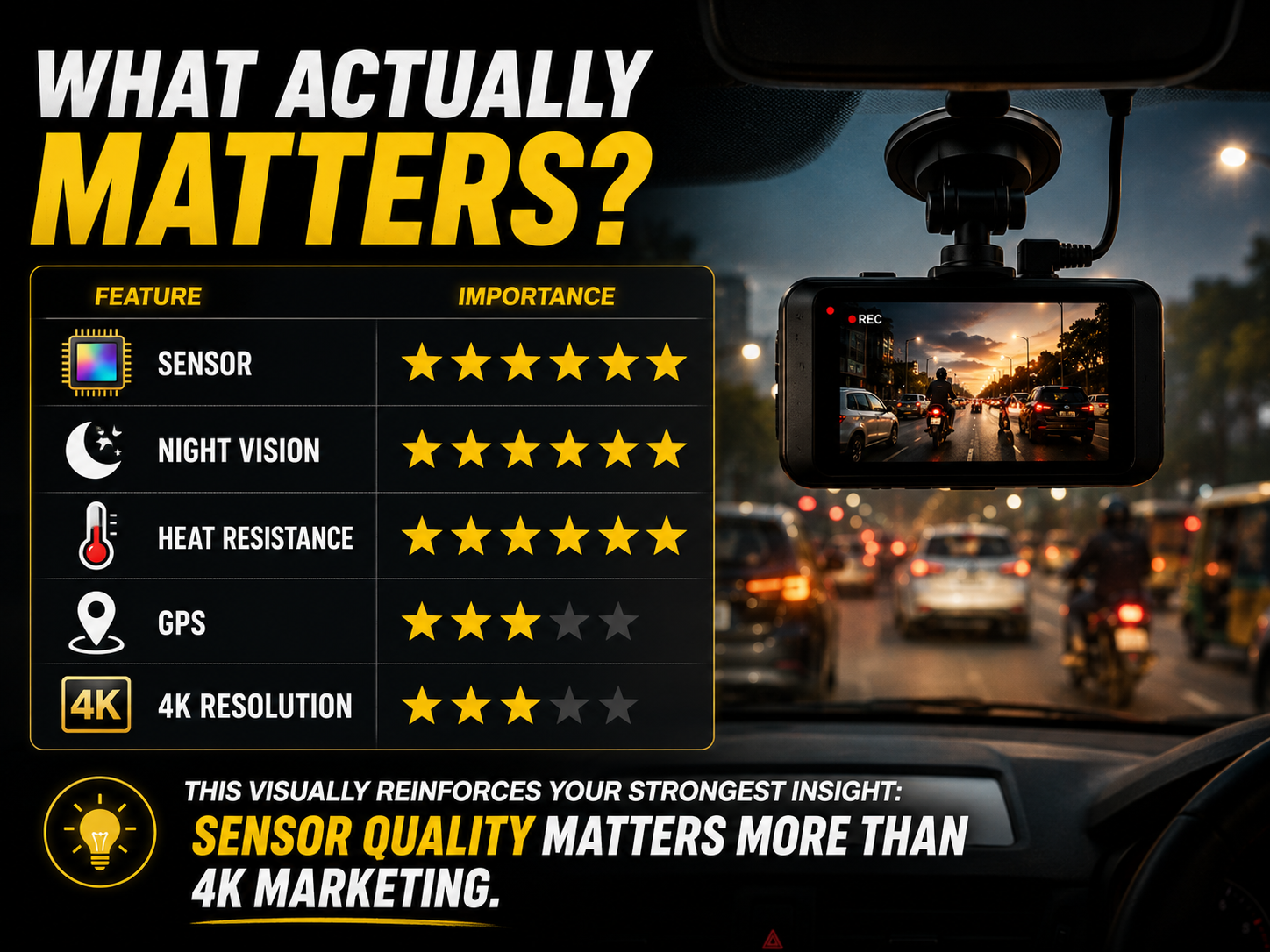
For Indian conditions, a dash cam must be rated to operate in temperatures above 60°C, as dashboard surface temperatures in parked cars regularly exceed 50°C in summer — a factor that disqualifies many internationally reviewed models sold in India.
Beyond heat, here’s what to actually look for:
Resolution: The 4K Trap
Honestly, resolution is where most buyers get misled. A lot of cameras marketed as “4K” in India use upscaled or interpolated footage rather than a true 4K sensor. Community testing — including from automotive enthusiast groups on Reddit — repeatedly shows that a good 2.5K or 1440p camera with a quality sensor will outperform a mediocre “4K” model in both daylight and low light.
For Indian roads, the practical test is whether you can read a number plate from 8–10 metres away in typical city lighting. Anything above 1440p with a decent sensor passes that test. 4K genuinely helps on fast highways where you’re identifying plates at greater distances.
Sensor Quality: The Real Differentiator
Look for cameras mentioning Sony STARVIS or Sony STARVIS 2 sensors. These handle India’s specific night driving challenges well: oncoming headlight glare, wet monsoon roads with strong reflections, and poorly lit state highways. A Wide Dynamic Range (WDR) processor helps too — it balances bright and dark areas in the same frame, so footage doesn’t get blown out when an autorickshaw’s LED headlights fill your lens.
Capacitor vs. Battery
If you park your car in direct sunlight, skip any camera that runs purely on a lithium battery. Capacitor-based cameras — like the Viofo A119 Mini 2 or Vantrue E1 Lite — handle heat cycles far better and tend to last significantly longer in Indian conditions.
GPS
GPS adds speed and location metadata to every clip. In practice, this is the difference between footage that shows what happened versus footage that shows what, where, at what speed, and when — the full picture that makes insurance and legal resolution much cleaner.
Smart mobility devices are increasingly connected—similar to AI smart glasses with navigation features, modern dash cams now combine GPS logging, voice control, and app-based automation.
Storage
Use a Class 10 / U3 endurance-rated microSD card — not a standard card. Standard cards degrade quickly under constant read/write cycles and heat. A 64GB endurance card stores roughly 4–6 hours of 1080p footage before loop overwrite; at 4K, expect 2–3 hours.
The 10 Best Dash Cams on Amazon India
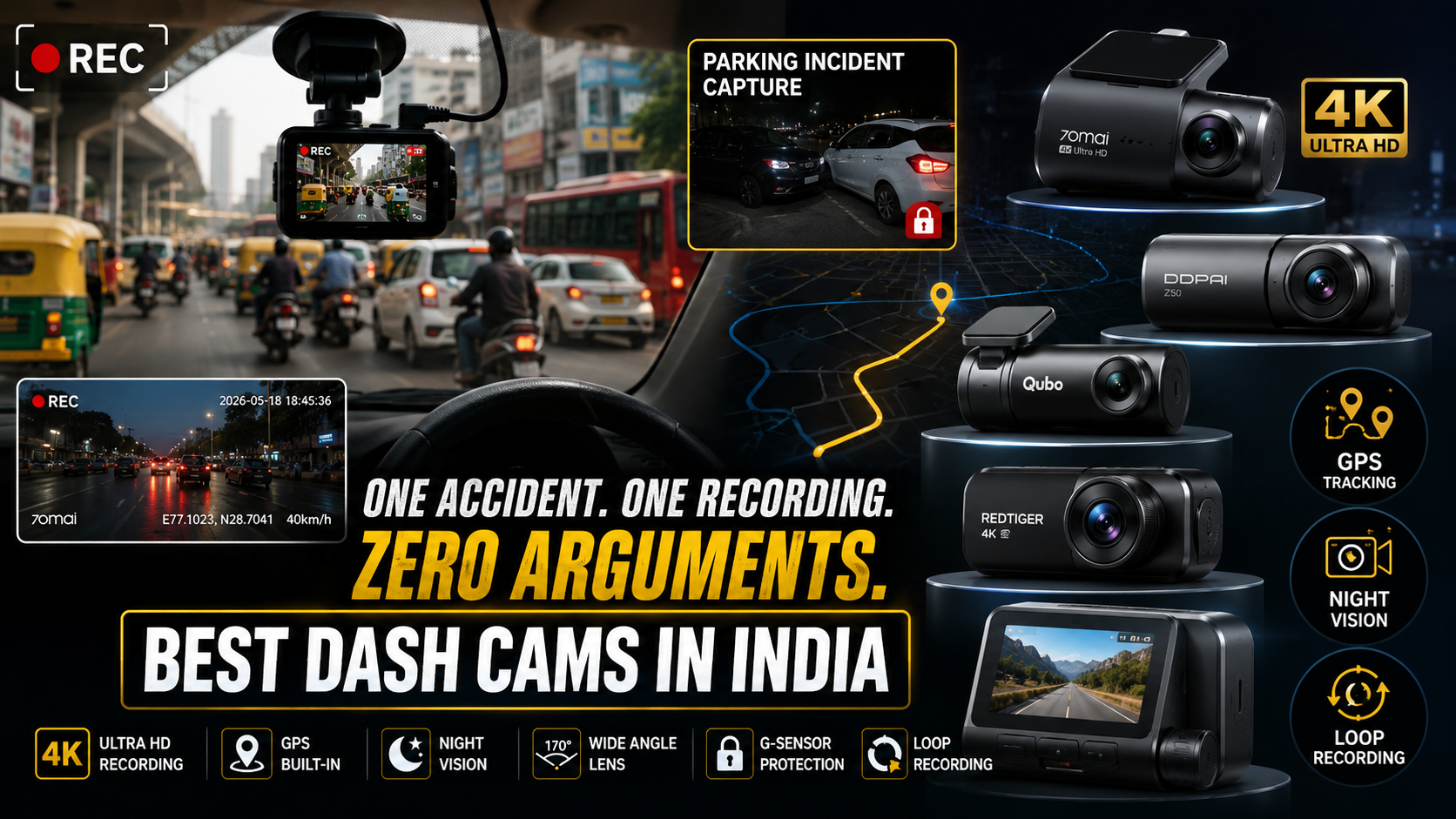
Each entry below follows the same structure: what it does well, who it’s for, and honest trade-offs. Prices are approximate Amazon.in ranges and may vary.
1. 70mai Dash Cam A400 — Best Overall Mid-Range Pick
Key specs: 1440p QHD | 140° FOV | Built-in GPS | Wi-Fi | Optional rear cam (RC09)
The A400 is the camera most Indian buyers should probably start with. It records clear QHD footage with GPS on every clip, connects to your phone via Wi-Fi for quick downloads, and the optional rear camera (sold separately) turns it into a dual-channel setup without buying a whole new unit. Night performance is solid — not class-leading, but dependable for city commutes.
The app can feel a little sluggish on older Android phones, and the rear cam being an add-on means a slightly higher effective cost. But as a standalone front camera with GPS? It’s excellent value.
Pros: GPS built-in at this price | App connectivity | Upgrade path to dual-channel
Cons: Rear cam sold separately | App performance varies by device
Amazon.in price range: ₹5,500–₹7,000
2. Vantrue E1 Lite — Best for Night Driving
Key specs: 2.5K | Sony STARVIS sensor | f/1.8 aperture | GPS | Capacitor | Parking mode
From what I’ve seen in side-by-side comparisons, the Vantrue E1 Lite consistently produces the cleanest night footage in its price range. The Sony STARVIS sensor and f/1.8 aperture combination handles headlight glare better than most cameras twice its size, and the capacitor build means it’ll survive Indian summers without the battery degradation you see in cheaper models.
It’s a front-only camera, which limits its usefulness for rear-end evidence. But for anyone regularly driving on NH highways after dark — think the Bengaluru–Mysuru expressway or the Mumbai–Goa coastal route — this is the most practical choice under ₹12,000.
Pros: Excellent low-light footage | Capacitor build for Indian heat | Compact and discreet
Cons: Front-only | Premium pricing for single-channel
Amazon.in price range: ₹10,500–₹12,500
3. Qubo Car Cam — Best Budget Pick Under ₹3,000
Key specs: 1080p Full HD | 140° FOV | G-sensor | Loop recording | Wi-Fi
Made for India by the Hero Group, the Qubo Car Cam is the sensible entry point if you’re buying your first dash cam or equipping a second vehicle. Daylight footage is clean and the app works well. It won’t impress at night, and there’s no GPS or parking mode — but at under ₹3,000, it’s not supposed to. It’s a starting point, not an endpoint.
Pros: Local brand with India-focused support | Simple app | Genuine value for the price
Cons: Average night vision | No GPS or parking mode
Amazon.in price range: ₹2,500–₹3,000
4. Viofo A119 Mini 2 — Best Compact Single-Channel Cam
Key specs: 1440p QHD | GPS | Capacitor | Ultra-compact form factor
The Viofo A119 Mini 2 is barely visible behind your rearview mirror — which is partly the point. Some drivers, particularly in cities with higher vehicle crime, prefer cameras that don’t advertise themselves. The capacitor handles heat reliably, GPS timestamps every clip, and QHD footage is genuinely usable for insurance evidence. The catch is no Wi-Fi, so clip extraction requires a card reader.
Pros: Near-invisible form factor | Capacitor build | GPS at this price
Cons: No Wi-Fi | No rear camera option
Amazon.in price range: ₹6,000–₹7,500
5. Garmin Dash Cam Mini 2 — Best for Set-and-Forget Reliability
Key specs: 1080p | 140° FOV | Automatic incident detection | Voice control | Cloud backup option
Garmin’s approach here is straightforward: this is a camera that just works. No complex setup, no fiddly app menus — you mount it, it records. It’s genuinely discreet and Garmin’s build quality holds up well over time. The optional Vault cloud backup is useful if you want footage automatically saved off-card after incidents.
The trade-off is that 1080p-only resolution and no built-in GPS feel like limitations at this price. You’re paying for reliability and brand trust, which is a legitimate purchase for drivers who don’t want to think about their dash cam.
Pros: Extremely reliable | Discreet | Cloud backup option
Cons: No GPS | 1080p only at a premium price
Amazon.in price range: ₹7,000–₹8,500
6. BlackVue DR750X-2CH — Best Premium Dual-Channel Cam
Key specs: 1080p front + 1080p rear | Wi-Fi + LTE | Cloud streaming | Parking mode with Park Guard alerts
Here’s the thing about the BlackVue: it’s not just a dash cam, it’s remote surveillance for your vehicle. The LTE connectivity lets you check a live stream of your parked car from anywhere — your phone shows you exactly what the camera sees. Park Guard sends instant alerts when the car is bumped or moved. For anyone with a premium vehicle parked in a risky area, this level of protection is genuinely worth the price.
The subscription-based cloud features add an ongoing cost, and this is firmly a professional installer’s job given the hardwiring complexity.
Pros: Real-time remote monitoring | Front and rear simultaneous 1080p | Park Guard alerts
Cons: Significant price premium | Cloud features require subscription | Professional installation recommended
Amazon.in price range: ₹28,000–₹35,000
7. Thinkware U1000 — Best 4K Dash Cam for India
Key specs: 4K UHD front + 2K rear | Sony STARVIS 2 | Radar parking sensor | GPS | Wi-Fi
The Thinkware U1000 is the camera for buyers who want the best available footage quality and don’t have to think about the price. True 4K front recording with a STARVIS 2 sensor means you can read plates at distances where most cameras give up. The radar-based parking sensor is genuinely more reliable than motion-triggered alternatives — it doesn’t false-trigger every time someone walks past your car.
At this price, professional installation is expected rather than optional.
Pros: Best available footage quality | Radar parking mode | Strong GPS logging
Cons: Very high price | Professional installation required for full functionality
Amazon.in price range: ₹35,000–₹45,000
8. Nextbase 222X — Best Front and Rear Combo for Mid Budget
Key specs: 1080p front + 720p rear | 3″ touch screen | G-sensor | Click&Go magnetic mount
The Nextbase 222X solves the dual-channel setup problem that puts a lot of buyers off: the rear camera plugs in cleanly without complex wiring, and the magnetic Click&Go mount makes it genuinely easy to remove before leaving the car in a sketchy area. The touch screen is convenient for reviewing clips on the camera itself without pulling out a card.
The rear camera’s 720p resolution is the main limitation — adequate for identifying vehicles, but you won’t be reading plates clearly. For mid-budget buyers who need front and rear coverage without the hassle, this is the most approachable option on the list.
Pros: Easiest dual-channel setup | Touch screen | Removable magnetic mount
Cons: Rear camera only 720p | Touch screen attracts dust and fingerprints
Amazon.in price range: ₹9,000–₹11,000
9. Rexing V1 — Best for Taxi and Cab Drivers
Key specs: 1080p | 170° ultra-wide FOV | Loop recording | G-sensor | Discreet design
The Rexing V1’s 170° field of view is wide enough to capture both the road ahead and a significant portion of the cabin with the right mounting position — useful for Ola and Uber drivers who want a record of passenger interactions as well as driving incidents. It’s simple, there’s no app dependency, no cloud subscription, no Wi-Fi to troubleshoot. It just records.
The lack of GPS and parking mode are real limitations, but for commercial drivers who need something reliable, affordable, and low-maintenance, it delivers.
Pros: 170° ultra-wide angle | No app/Wi-Fi required | Affordable and reliable
Cons: No GPS | No parking mode
Amazon.in price range: ₹3,500–₹4,500
10. Mio MiVue C380 — Best for Highway Driving
Key specs: 1080p | GPS | Speed camera alerts | Lane departure warning | f/2.0 aperture
The Mio MiVue C380 is built specifically around highway driving. The GPS-linked speed camera database covers major NH routes, lane departure warning is functional (not just a checkbox), and the f/2.0 aperture produces usable footage at highway speeds in fading light. It’s a bit bulkier than most competitors, and the speed camera database needs periodic updates to stay current.
For drivers doing regular long-distance trips — Mumbai–Pune, Delhi–Jaipur, Chennai–Bengaluru — the active safety features add genuine value over a basic recording camera.
Pros: Built-in GPS with speed camera alerts | Lane departure warning | Good aperture for highway speeds
Cons: Requires database updates | Bulkier form factor
Amazon.in price range: ₹6,500–₹8,000
Quick Comparison: All 10 at a Glance
| Product | Price Range | Resolution | GPS | Dual Channel | Best For |
|---|---|---|---|---|---|
| 70mai A400 | ₹5,500–₹7,000 | 1440p | ✔ | Optional | Overall mid-range |
| Vantrue E1 Lite | ₹10,500–₹12,500 | 2.5K | ✔ | ✕ | Night driving |
| Qubo Car Cam | ₹2,500–₹3,000 | 1080p | ✕ | ✕ | Budget / first-time buyers |
| Viofo A119 Mini 2 | ₹6,000–₹7,500 | 1440p | ✔ | ✕ | Compact & discreet |
| Garmin Mini 2 | ₹7,000–₹8,500 | 1080p | ✕ | ✕ | Reliability & simplicity |
| BlackVue DR750X-2CH | ₹28,000–₹35,000 | 1080p + 1080p | ✔ | ✔ | Premium remote monitoring |
| Thinkware U1000 | ₹35,000–₹45,000 | 4K + 2K | ✔ | ✔ | Best 4K footage |
| Nextbase 222X | ₹9,000–₹11,000 | 1080p + 720p | ✕ | ✔ | Mid-budget front + rear |
| Rexing V1 | ₹3,500–₹4,500 | 1080p | ✕ | ✕ | Taxi/cab drivers |
| Mio MiVue C380 | ₹6,500–₹8,000 | 1080p | ✔ | ✕ | Highway driving |
Front Camera or Dual-Channel — Which Do You Actually Need?
A dual-channel dash cam — recording both the front windshield and rear window simultaneously — provides substantially better evidence for rear-end collisions and parking incidents, which are among the most common vehicle damage scenarios in Indian cities.
In practice, the decision usually comes down to three questions: Where do you park? What type of driving do you do most? And what’s your budget?
If you park on the street, in apartment complexes, or in commercial parking areas with no attendant, a rear camera is worth the extra cost. Rear-end collisions in stop-and-go Bengaluru or Mumbai traffic are frequent enough that front-only footage leaves you without evidence exactly when you most need it.
On the other hand, if you’re primarily a highway driver who parks in secure facilities, a high-quality front camera — like the Vantrue E1 Lite or Viofo A119 Mini 2 — can make more sense than a budget dual-channel compromise. A better front sensor beats a mediocre two-camera setup.
Decision framework:
- Get front-only if: budget under ₹5,000, secure parking, primarily highway driving
- Get dual-channel if: street/apartment parking, frequent city driving, premium vehicle, or you’ve already had a rear incident
Installation: What to Get Right From the Start
Installing a dash cam incorrectly — particularly a hardwire kit — can affect your vehicle’s electrical system and in some cases complicate warranty claims.
The basics: place the camera behind the rearview mirror, positioned high on the windshield. RTO guidelines prohibit mounting anything that obstructs the driver’s direct line of sight, so stay out of the lower windshield zone.
For power, the cigarette lighter socket is the easiest option but leaves a cable running visibly across the dashboard. A hardwire kit gives you cleaner installation and unlocks parking mode — it connects to your car’s fuse box and draws minimal current from an accessory circuit. If you’re not comfortable with car electrics, get this done professionally.
Always format the microSD card using the camera’s built-in format function, not your laptop. This creates the correct folder structure for loop recording and G-sensor saves. Set your G-sensor sensitivity to the middle of the range initially — too high and every pothole triggers a locked clip; too low and a genuine impact gets overwritten. Calibrate from there based on your usual roads.
Can You Actually Use Dash Cam Footage in an Insurance Claim in India?
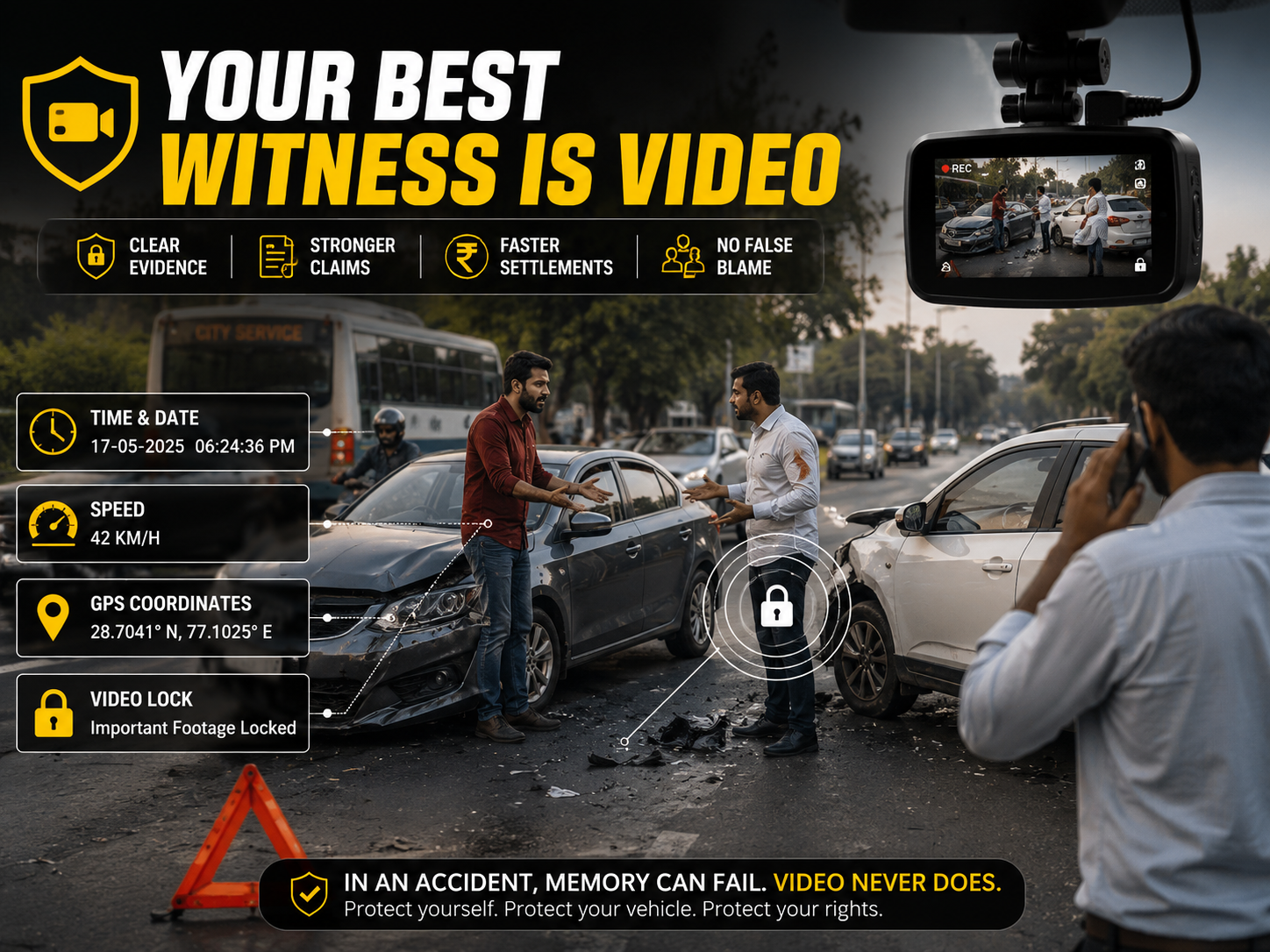
Yes — and increasingly, it matters. Dash cam footage is accepted as supplementary evidence by major Indian insurers, and GPS-timestamped recordings carry additional legal weight when disputes reach consumer courts under the Motor Vehicles Act, 2019.
In practice, you submit the video file alongside your standard claim documentation: FIR copy, repair estimate, and claim form. Most insurers accept MP4 or MOV formats. GPS data embedded in the footage — showing your speed and location at the time of incident — is particularly useful when the other party disputes the basic facts of what happened.
Without GPS, footage can still be challenged on the grounds of timestamp accuracy or location. With GPS, you’re presenting timestamped, location-verified evidence that’s much harder to dismiss. According to the Coalition Against Insurance Fraud, fraud causes billions in annual losses globally — Source: Coalition Against Insurance Fraud, 2025 — and Indian insurers are increasingly aware of this as a problem.
Getting Set Up After Purchase: Three Things Most Buyers Skip
Most people unbox the camera, mount it, and start driving. That works, but there are three setup steps that actually determine how useful the camera is when something goes wrong.
First, test parking mode before you rely on it. Park the car, walk away, gently tap the bumper, then review the footage. Confirm it captured the event and saved it correctly.
Second, check your loop recording settings. Make sure the recording interval is set appropriately for your card size — most cameras default to 3-minute loops, which is fine for 64GB, but you can extend to 5-minute loops with 128GB for less frequent rewrites.
Third, if your camera supports cloud backup (BlackVue, Garmin Vault), set it up before you need it. The worst time to discover your cloud sync wasn’t configured is after an incident.
Conclusion
A dash cam is no longer a luxury for Indian car owners. It’s a practical piece of kit that pays for itself the first time it helps you settle an insurance dispute, document a parking incident, or disprove a false claim — which, on Indian roads, isn’t a matter of if but when.
For most buyers, the 70mai A400 is where to start — GPS, 1440p, and app connectivity at a fair price. For night driving, the Vantrue E1 Lite is the clearest performer. The Qubo Car Cam covers your bases if budget is the main constraint. Taxi drivers will find the Rexing V1 the most practical and reliable. For the best dash camera for Indian roads overall in the premium category, the Thinkware U1000 is simply the best footage quality you can buy.
Whatever you choose — buy it, install it properly, format the card, test the parking mode, and use an endurance-rated microSD card. The best dash cam for Indian roads is the one that’s actually set up and running when you need it.
FAQ
FAQ 1: Are Dash Cameras Legal in India?
Yes, dash cameras are legal in private vehicles in India. There’s no central legislation restricting their use. Placement must follow RTO guidelines — cameras should be behind the rearview mirror and must not obstruct the driver’s line of sight. Recording on public roads is permitted.
FAQ 2: Can a Dash Cam Reduce Insurance Disputes?
Significantly, yes. GPS-timestamped video evidence can resolve disputes about fault, speed, and road position that would otherwise come down to conflicting accounts. Major Indian insurers accept dash cam footage as supplementary claim documentation, and it carries legal weight in consumer court proceedings under the Motor Vehicles Act, 2019.
FAQ 3: How Long Do Dash Cam Recordings Last?
It depends on resolution and card size. On a 64GB endurance card: roughly 4–6 hours at 1080p, 3–4 hours at 1440p, and 2–3 hours at 4K before loop overwrite begins. G-sensor clips are locked automatically and retained until manually deleted. For most daily commuters, 64GB is sufficient; drivers who want a longer buffer should go with 128GB.
FAQ 4: Is a Front Camera Enough, or Should I Buy a Dual-Channel Dash Cam?
For highway driving and basic protection, a front camera is workable. For city driving, apartment parking, and complete incident coverage — especially rear-end collisions, which are among the most disputed accident types in India — a dual-channel setup is meaningfully better. If the budget allows, dual-channel is almost always the right call.
FAQ 5: Are Expensive Dash Cams Worth It?
For most Indian drivers, the ₹6,000–₹13,000 range delivers the best practical value: you get GPS, better night sensors, parking mode, and durable build quality without paying for features you won’t use. Cameras above ₹20,000 — like the BlackVue or Thinkware — are worth it if you own a premium vehicle, need cloud monitoring, or manage a commercial fleet. For daily commuting in a standard car, the mid-range options are more than enough.
Written by Amit Verma: Amit Verma is a technology content writer covering consumer electronics, automotive gadgets, and practical product buying guides for everyday users. His work focuses on helping readers navigate technology purchases through clear, research-driven content, product comparisons, and easy-to-understand recommendations.
Affiliate Disclosure: This article may contain affiliate links. If you purchase a product through these links, we may earn a small commission at no additional cost to you. Our recommendations are based on independent research, product comparisons, publicly available information, and editorial evaluation. Affiliate partnerships do not influence our content, rankings, or recommendations.
Disclaimer: This article is based on product research, market analysis, manufacturer specifications, customer feedback, and publicly available information regarding dash cameras and automotive safety accessories available in India. Product features, firmware updates, pricing, availability, warranty terms, and compatibility may change over time. Readers are encouraged to verify the latest specifications, installation requirements, storage compatibility, and regional support directly with manufacturers or sellers before making a purchase decision. Any information provided in this article is intended for educational and informational purposes only and should not be considered professional automotive, legal, or insurance advice. This content was initially drafted with AI assistance and has been carefully reviewed, edited, refined, and fact-checked by human editors to ensure accuracy, clarity, originality, and practical relevance for readers.