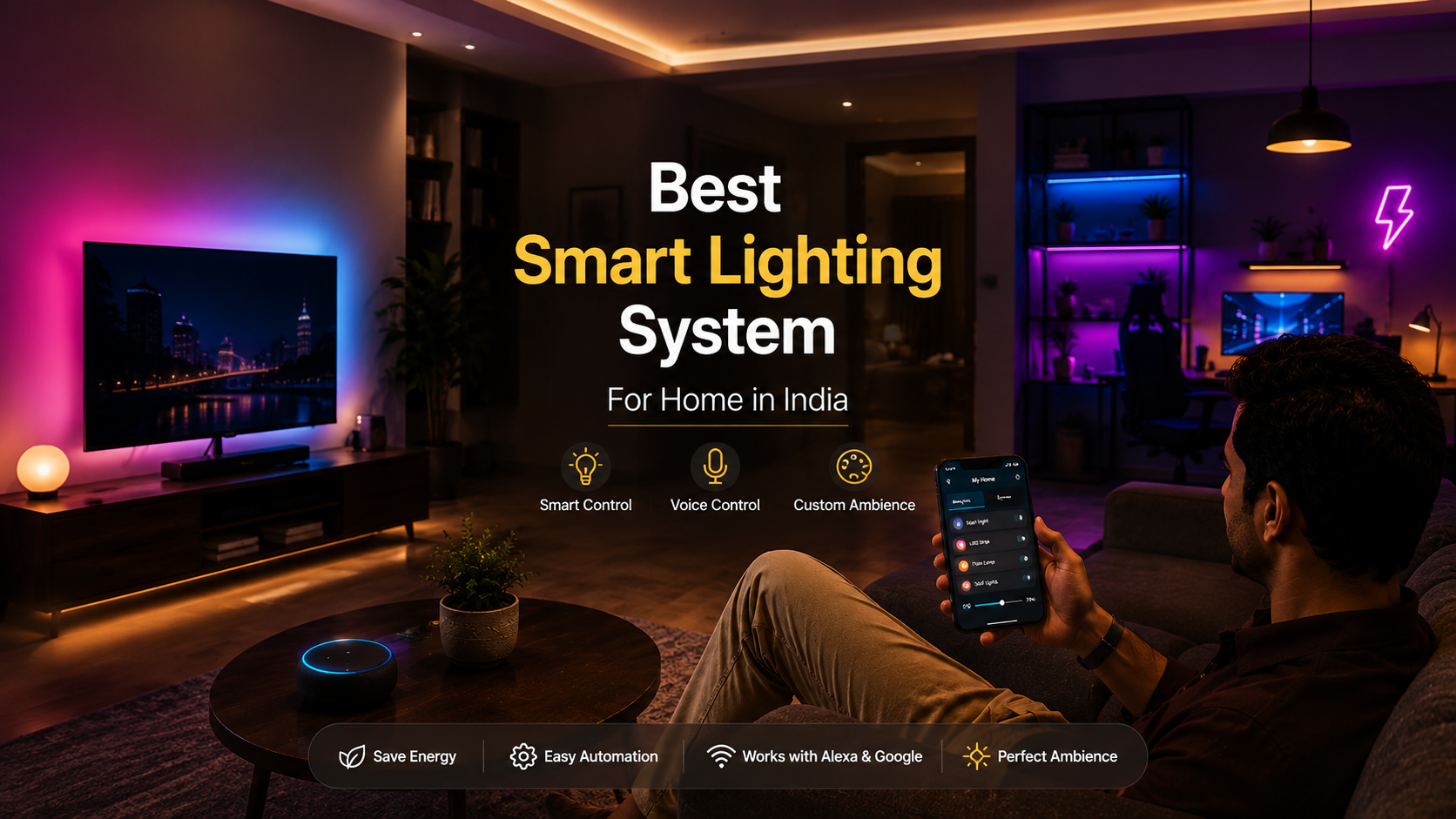
Best Smart Lighting System for Home in India (2026): Honest Reviews, Real Prices & a Buyer’s Guide That Actually Helps
By Rohan Mehta, Consumer Tech Analyst — IoT devices, home automation, and smart home ecosystems.
Summarize this blog post with: ChatGPT | Perplexity | Claude | Grok
Most people buying smart lights in India start with one Wi-Fi bulb and quickly realize — often the hard way — that the ecosystem matters far more than the bulb itself. You can buy the cheapest smart bulb on Amazon, get it working with Alexa, feel genuinely impressed for a week, and then hit a wall: the app keeps dropping the connection, the bulb resets to full brightness every time there’s a power cut, or you realize it doesn’t work with the Google Home setup your flatmate already has going.
That’s the real challenge here. It’s not finding a smart light — there are hundreds of them. It’s choosing a system that stays reliable six months from now, plays nicely with your home setup, and doesn’t make you regret your decision every time a visitor asks why your smart bulb isn’t responding to voice commands.
I’ve been researching and testing smart home devices in the Indian market since 2019, and in this guide I’ll walk you through exactly what to look for, which brands are actually worth your money, and how to build a setup that works — whether you’re renting a one-bedroom apartment or automating a new villa. No fluff. Just practical advice with real INR pricing.
Table of Contents
ToggleKey Takeaways
- Smart lighting systems combine connected bulbs, switches, sensors, and automation features controlled through apps or voice assistants — they’re a different category from regular LED bulbs, not just a fancier version.
- The best smart lighting system for Indian homes depends on three things: your budget (you can start from as low as ₹500–₹800 per bulb), your existing smart home ecosystem, and whether you’re okay with managing a hub.
- Philips Hue is the gold standard for reliability and ecosystem depth; Wipro and Havells offer the best value for most Indian households; WiZ is the easiest system to get started with.
- Smart lighting can reduce household electricity costs by 30–50% versus incandescent bulbs — and automation features like scheduling and motion sensing mean you’re not wasting electricity on empty rooms.
- Hub-free Wi-Fi bulbs from brands like WiZ, Syska, and Wipro are the most practical starting point for beginners — you just need a 2.4 GHz Wi-Fi network and a smartphone.
- Always check for ISI certification and 200–240V voltage tolerance before buying anything, because India’s power supply fluctuates more than most smart bulb manufacturers account for.
- Start with one room. Automate your bedroom or living room first, see how it fits your routine, and then expand. Overbuying at the start is the most common mistake Indian smart home buyers make.
What Is a Smart Lighting System and How Does It Actually Work?
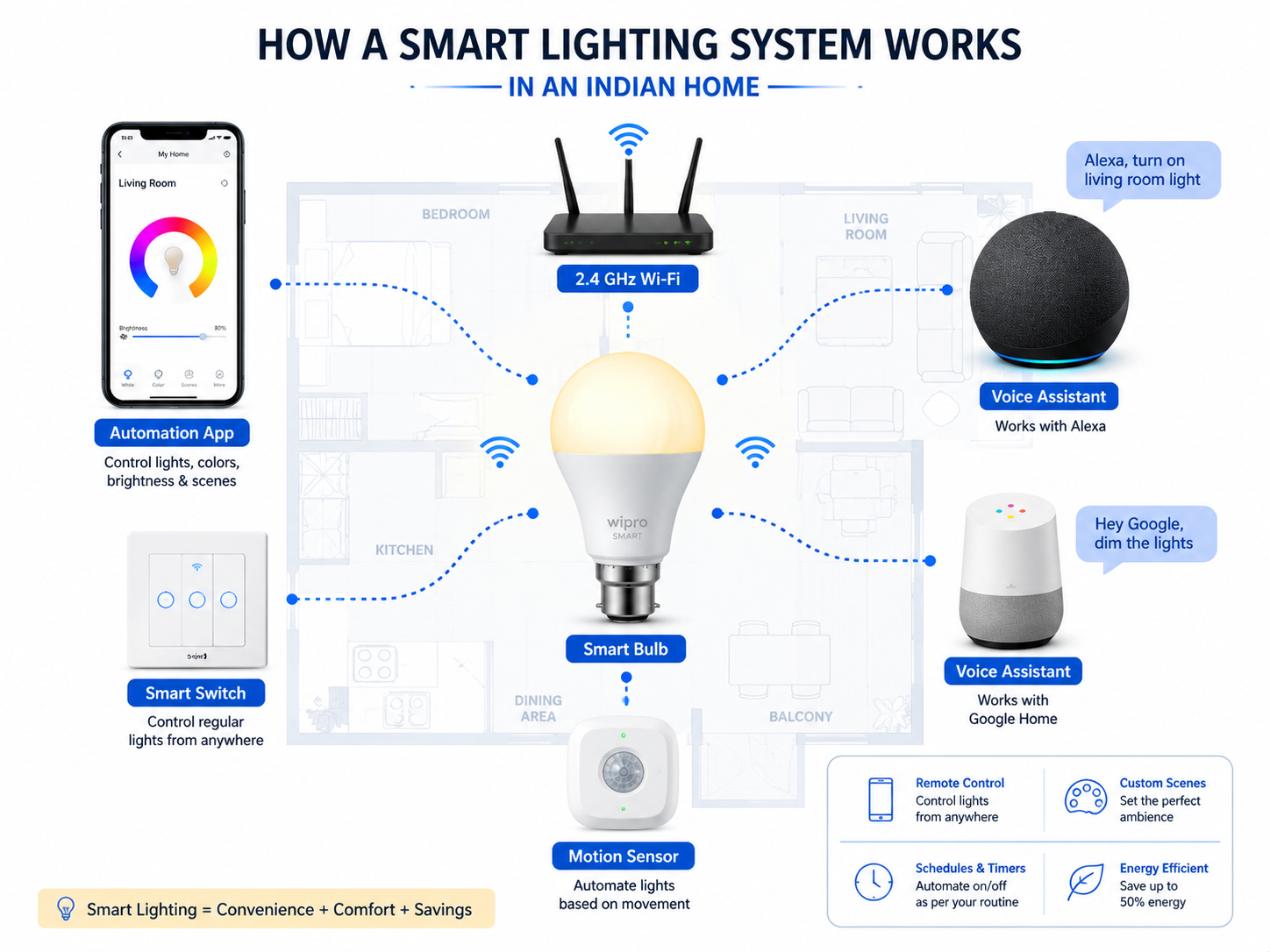
A smart lighting system is a network of connected lights and controls that you can automate or manage through apps, voice assistants, or sensors — and that’s what separates it from a regular LED bulb, which just sits there and glows.
Here’s the thing though: “smart lighting” covers a pretty wide range of products. It’s not just bulbs. It includes smart switches (so you can make any existing light controllable), LED strips for gaming setups and TV backlighting, downlights for modern interiors, motion sensors, and in more advanced setups, a central hub that coordinates everything. Understanding what you actually need before you buy is half the battle.
The four main components you’ll encounter are:
- Smart bulbs — the easiest starting point, literally just screw them in
- Smart switches — better for permanent setups and family homes where not everyone wants to use an app
- Hubs or bridges — required by some systems (like Philips Hue) to connect devices to your network
- Controllers — your phone app, Alexa, Google Assistant, etc.
Most Indian apartments can get started with just a smart bulb and a phone. No hub needed.
The Indian smart lighting market is expected to grow at 27.56% CAGR between 2026 and 2034 — Source: IMARC Group, 2026. That growth is being driven by falling bulb prices, rising smart speaker adoption, and the fact that more people are actually trying this stuff and finding it genuinely useful rather than a gimmick.
Wi-Fi vs. Zigbee vs. Bluetooth - Which One Should You Care About?
Honestly, for most people reading this, the answer is: Wi-Fi, and don’t overthink it. But let me explain the differences properly because they do matter if you’re planning something more ambitious.
Wi-Fi smart lights connect directly to your home router. No extra hardware, easy setup, works with Alexa and Google Home out of the box. The downside is that each bulb occupies a slot on your router, and if you’re planning to run 20+ smart bulbs, older routers can start struggling.
Zigbee smart lights (used by Philips Hue) don’t connect to your Wi-Fi at all. Instead, they form their own low-power mesh network via a hub, which then connects to your router. This sounds more complicated — and it is, slightly — but the payoff is better speed, better range, and no Wi-Fi congestion in larger homes. Zigbee-based systems reduce Wi-Fi stress while improving reliability across larger installations — Source: TechRadar, 2025.
Bluetooth bulbs are the most limited. They only work within about 10 metres and can’t be controlled remotely. Fine for a single room where you just want voice control, not ideal for anything more.
One more thing worth mentioning: the Matter protocol. It’s a newer universal smart home standard that’s supposed to let devices from different brands talk to each other more seamlessly. Philips Hue (through its newer bridges) and WiZ already support it. If you’re planning a bigger setup and want to mix brands without headaches, Matter compatibility is worth looking for.
| Type | Best For | Setup Difficulty | Typical INR Price |
|---|---|---|---|
| Smart Bulbs (Wi-Fi) | Beginners, renters | Very easy | ₹400–₹3,000 |
| Smart Switches | Permanent setups, family homes | Moderate | ₹1,500–₹8,000 |
| LED Strips | Gaming, TV backlighting | Easy | ₹1,000–₹10,000 |
| Smart Downlights | Modern interiors | Moderate | ₹1,500–₹5,000 |
| Zigbee Hub Systems | Large homes, advanced automation | Advanced | ₹5,000–₹12,000+ |
Why Smart Lighting Is Actually Worth It for Indian Homes (Not Just a Fancy Toy)
I’ll be upfront: when smart bulbs first became affordable in India around 2018–2019, I was skeptical too. ₹800 for a single bulb when you could buy a decent LED for ₹80? The math didn’t seem to work.
But here’s what changes after you actually live with smart lighting for a few months.
The energy savings are real. Smart LED bulbs consume up to 80% less energy than incandescent bulbs, and when you layer in automation — lights that switch off automatically when a room is empty, or bedroom lights that dim at 10 PM without you touching anything — you can realistically cut your household lighting electricity costs by 30–50% annually. For a family in a metro city paying ₹6–₹9 per unit of electricity, that compounds quickly. LED lighting already holds a 72.4% share of India’s lighting market in 2025 — Source: IMARC Group, 2025 — and smart LEDs are the logical next step in that evolution.
Beyond the bills, though, it’s the daily convenience that gets you hooked. Scheduling your porch light to turn on at sunset automatically. Dimming your bedroom to a warm 20% before sleep. Not having to get up from bed to turn off the bathroom light you forgot about. These things sound small, but they genuinely add up.
The security angle is underrated. Away mode — where your lights simulate occupancy on a schedule when you’re travelling — is a simple but effective deterrent. Combine it with a smart security camera and you’ve built real peace of mind without a full security system.
And most Indian households already have an Alexa Echo Dot or Google Nest Mini sitting around. Smart lights are the most satisfying first step to actually using those devices to their potential.
What to Look for Before Buying: The India-Specific Checklist
This section is where most buying guides fail Indian consumers. They give you generic global criteria without accounting for the specific realities of Indian homes. So let me be direct about what actually matters here.
Does It Support 2.4 GHz Wi-Fi?
Almost every smart bulb in India requires a 2.4 GHz Wi-Fi connection — not 5 GHz. This trips people up because modern dual-band routers broadcast both frequencies, and your phone might be connected to the 5 GHz band by default. During setup, you’ll need to temporarily switch your phone to the 2.4 GHz network.
If you have an older router from BSNL or an early-generation Jio Fi, you might only have 2.4 GHz anyway, which is actually fine for smart bulbs. Just double-check the product specs before buying.
Voltage Tolerance: Non-Negotiable in India
Indian buyers should prioritize smart bulbs rated for 200–240V with ISI or BEE certification, because India’s power supply fluctuates more than manufacturers from Europe or North America typically design for. Our nominal supply is 220V, but in many cities and towns — especially during peak demand or monsoon season — it can dip to 190V or surge past 250V. A cheap smart bulb not designed for this range will fail faster, and in worst cases, it’s a safety risk.
Always look for the ISI mark (Bureau of Indian Standards) or a BEE star rating on the packaging or product listing.
Hub-Based vs. Hub-Free: The Real Trade-Off
From what I’ve seen, most people buying their first smart lighting setup in India go hub-free — and that’s the right call. Hub-free systems (WiZ, Syska, Wipro, TP-Link Tapo) connect directly to your Wi-Fi, the setup takes about five minutes, and you’re done.
Hub-based systems like Philips Hue require an additional device (the Hue Bridge, around ₹7,000) but offer faster response times, rock-solid reliability, and much better performance if you’re running 15+ bulbs across multiple rooms. If you’re setting up a whole flat or villa, the hub investment pays for itself in reliability alone.
Long-Term App Support — More Important Than It Sounds
This is something first-time buyers never think about and experienced buyers always mention. A smart bulb is only as useful as the app that controls it. From what I’ve seen on Reddit and consumer forums, several budget brands in India have quietly discontinued app support or stopped pushing software updates — leaving buyers with bulbs they can still switch on manually but can no longer automate or control remotely.
Stick to brands with established ecosystems: Philips (Hue and WiZ), Wipro, Havells, Syska, and TP-Link Tapo. All have shown reasonable long-term commitment to their apps in the Indian market.
The Best Smart Lighting Systems in India — Honestly Ranked and Reviewed
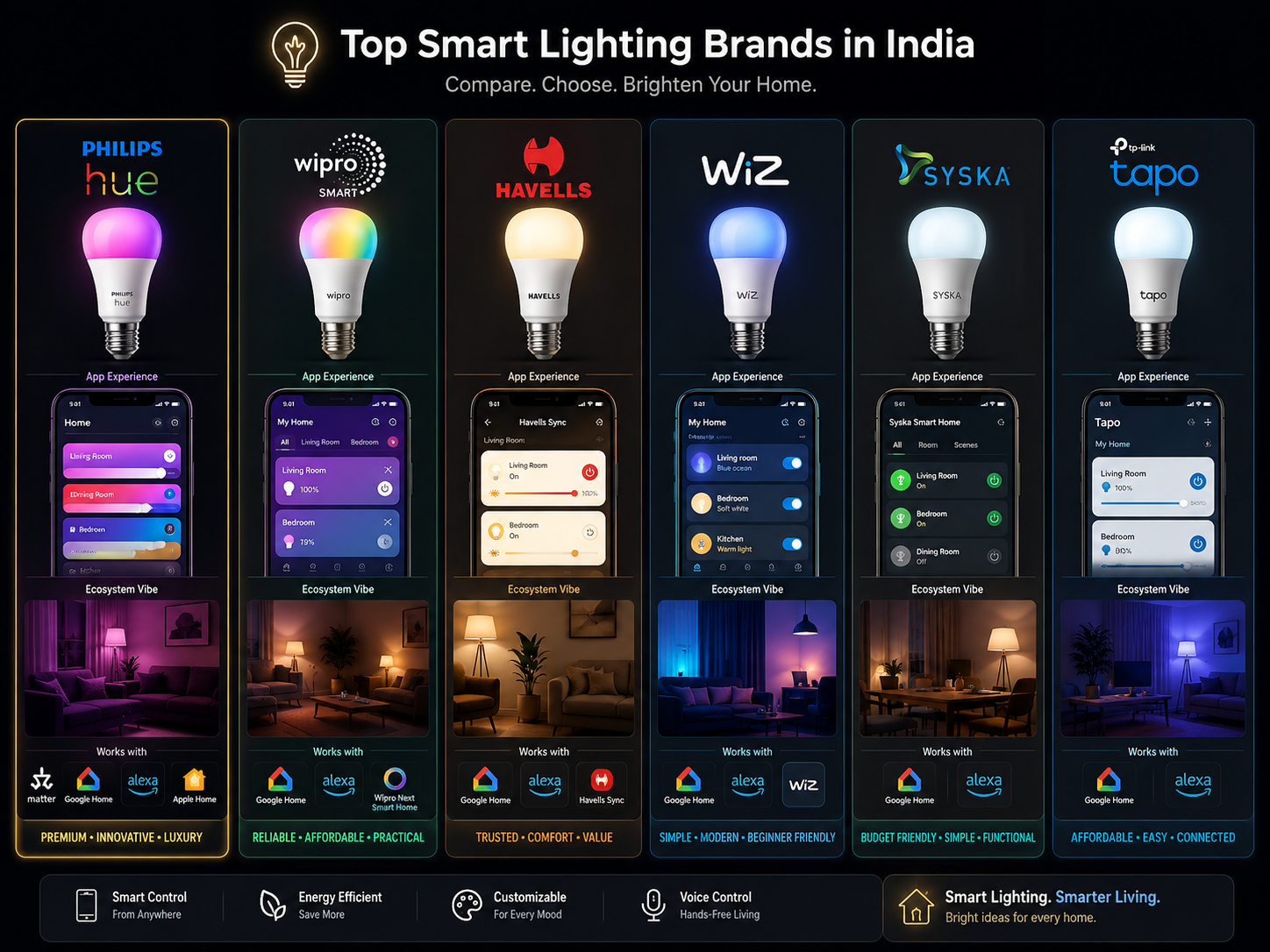
In India, the best smart lighting systems for home use include Philips Hue for premium users, Wipro and Havells for mid-range households, and WiZ or Crompton for budget-first buyers — all available on Amazon.in and Flipkart with reasonable warranty support.
Here’s a full comparison before we dig into individual reviews:
| Brand & Model | Price Range (INR) | Hub Required | Ecosystem | Best For | Honest Limitation |
|---|---|---|---|---|---|
| Philips Hue White | ₹2,500–₹3,500/bulb | Yes (Hue Bridge, ~₹7,000) | Alexa, Google, HomeKit | Premium users, large homes | High upfront cost |
| Wipro Smart Lite | ₹700–₹1,100/bulb | No | Alexa, Google Home | Mid-range apartments | App reliability inconsistent |
| Havells Adore Smart | ₹900–₹1,500/bulb | No | Alexa, Google Home | Design-conscious mid-range buyers | Smaller ecosystem |
| Syska Smart LED | ₹600–₹900/bulb | No | Alexa, Google Home | First-time buyers | App occasionally loses devices |
| Signify WiZ | ₹700–₹1,200/bulb | No | Alexa, Google Home | Absolute beginners | No HomeKit support |
| Xiaomi Yeelight | ₹800–₹1,400/bulb | No | Alexa, Google, Mi Home | Value-for-money buyers | Requires Mi Home app, China servers |
| Crompton Smart | ₹550–₹850/bulb | No | Alexa, Google Home | Strict budget buyers | Fewer advanced features |
| TP-Link Tapo | ₹700–₹1,100/bulb | No | Alexa, Google Home | Reliable app experience | Newer brand in India |
Philips Hue — The Best Overall Smart Lighting Ecosystem in India
Philips Hue is considered the premium smart lighting ecosystem because of its advanced automation features, extensive device range, and strong long-term ecosystem support — and honestly, that reputation is deserved. I’ve tested a lot of smart lighting products over the years, and nothing else comes close to Hue’s reliability.
The Zigbee mesh network means your lights respond almost instantly to commands — no noticeable lag like you sometimes get with Wi-Fi bulbs. The Hue app is genuinely the best in this category: intuitive, feature-rich, with entertainment sync modes that can make your TV backlight pulse with on-screen colours. Apple HomeKit support is a big deal for iOS users who are invested in that ecosystem.
The downsides are real though. You’ll spend ₹7,000 just on the Hue Bridge before buying a single bulb. A starter kit with the bridge and a few bulbs can easily run ₹15,000–₹20,000. That’s a serious commitment. And if your home is on the smaller side — a 1BHK or 2BHK apartment — you probably don’t need Zigbee’s scalability advantages anyway.
Best for: Premium apartments, villas, serious smart-home enthusiasts, multi-room setups, and anyone who wants ecosystem stability for the next decade.
Avoid if: Your budget is under ₹10,000 for getting started or you’re not planning to expand beyond a few bulbs.
Wipro Smart Lite — Best Mid-Range Pick for Indian Homes
Wipro is one of India’s most trusted electrical brands, and that trust carries over into its smart lighting range. From what I’ve seen, Wipro Smart Lite hits the sweet spot that most Indian households actually need: decent app quality, reliable Alexa and Google Home integration, hub-free setup, and pricing that doesn’t feel like you’re gambling on a budget unknown.
Setup is genuinely straightforward. Screw in the bulb, open the Wipro Smart app, connect to your 2.4 GHz Wi-Fi, and you’re controlling it within five minutes. Alexa and Google Home pairing works reliably. The build quality feels solid — you can tell it’s not the cheapest component possible.
The honest limitation is that the app’s reliability can be inconsistent if you push it hard. For a bedroom or living room with a couple of bulbs on a schedule, it’s excellent. For a more complex multi-room setup with lots of automation rules, it can occasionally be frustrating. Reddit users across multiple threads on r/GadgetsIndia frequently describe Wipro as excellent for first-time automation but inconsistent for larger setups.
Best for: Mid-range apartments, first-time smart home buyers who want a trusted Indian brand, and anyone who wants reliable basics without premium pricing.
Avoid if: You’re building a complex multi-room automation system — Philips Hue is more appropriate at that scale.
Havells — The Best Made-in-India Smart Lighting Option
Havells is a different kind of value proposition. It’s not the cheapest option, and it’s not the most feature-rich. But it brings something that matters a lot in India: genuine after-sales support. If something goes wrong with a Havells product, you can walk into a service centre in most Indian cities. That’s not something you can say about Xiaomi, TP-Link, or some of the other options here.
The design quality is noticeably good — Havells products tend to look better installed in a home than some of the more utilitarian budget options. Voice assistant compatibility with Alexa and Google Home works reliably. The app is reasonable without being impressive.
Where Havells falls short is ecosystem depth. There are fewer product types than Philips or even Wipro, and the automation features are more basic. But for a family home where long-term support and in-person service matter more than cutting-edge features, Havells is a genuinely strong choice.
Best for: Family homes, buyers who prioritize Indian after-sales support, mid-range automation setups.
Avoid if: You want advanced automation features or a wide product range.
WiZ (by Signify) - Honestly the Easiest to Get Started With
WiZ deserves special mention because it is, from my experience, the genuinely simplest smart lighting system to set up in India today. The app is clean and intuitive, the setup wizard holds your hand through the whole process, and it’s done in under three minutes. No hub, no bridge, nothing extra.
One feature worth highlighting specifically for Indian homes: SpaceSense technology, which detects motion using Wi-Fi signal disturbances rather than a separate motion sensor. Your lights can respond to movement without any additional hardware. That’s clever design and saves you money.
WiZ supports Alexa and Google Home reliably, and Matter compatibility means it’s reasonably future-proofed. The main gap is Apple HomeKit — if you’re an iPhone user invested in the Apple ecosystem, WiZ won’t work for you.
Best for: Absolute beginners, renters, anyone who wants a no-drama setup experience.
Avoid if: You need Apple HomeKit or are planning a large-scale Zigbee-based automation.
Syska Smart LED — Good for Experimentation, With Caveats
Syska is one of India’s best-known lighting brands and its smart range is widely available, affordable, and reasonably easy to set up. For someone who wants to try smart lighting for the first time without spending too much, Syska makes sense.
That said — honestly — I’d flag some real-world limitations that are worth knowing upfront. The Syska Smart app has a documented tendency to lose device connections and require re-pairing. Some users on Reddit have reported concerns about long-term app support continuity.
For casual use in a bedroom with a simple on/off schedule, it works fine. For anything more demanding, I’d step up to Wipro or WiZ.
Best for: Trial setups, budget buyers, basic scheduling in a single room.
Avoid if: You need consistent reliability or plan to expand your setup significantly.
Are Smart Lights Safe to Use With India's 220V Power Supply?
Yes — as long as you buy the right products. Smart lights rated for 200–240V voltage tolerance are safe for Indian electrical standards. The problem is that not every smart bulb sold in India is properly rated for the voltage fluctuations that are common here, especially in smaller cities and during summer peak-demand months.
This is genuinely important and not just a technicality. A bulb not designed for India’s supply range will fail faster, perform inconsistently, and in edge cases can be a fire or electrical hazard. Always verify that your bulb carries an ISI mark from the Bureau of Indian Standards. International brands sold through Amazon.in (like Philips Hue and WiZ) are generally well-tested for Indian conditions. Some very cheap no-name bulbs are not.
Do Smart Lights Work During Power Cuts or Wi-Fi Outages?
This is one of the most common questions from Indian buyers, and the answer is slightly nuanced. During a power cut, smart lights don’t work — they’re lights, they need electricity. That’s straightforward.
The more interesting question is what happens after power is restored. Most quality smart bulbs (Syska, WiZ, Wipro, Philips Hue) remember their previous state and return to it when power comes back. Some cheaper models reset to full brightness every single time — which is annoying at best and genuinely disruptive at 2 AM.
During Wi-Fi outages, the situation is more manageable. Most smart bulbs can still be switched on and off manually via the wall switch. Some support direct Bluetooth control from your phone as a fallback. You just lose remote control and voice commands until your internet is restored. For most Indian homes, this is a perfectly reasonable trade-off.
How to Set Up a Smart Lighting System at Home - No Electrician Needed
Setting up a hub-free Wi-Fi smart bulb takes under ten minutes. Here’s the exact process:
- Check your socket type — most Indian homes use B22 (bayonet) or E27 (screw) sockets. Buy the right fitting.
- Screw in the smart bulb and turn on the wall switch. The bulb should flash briefly — that means it’s in pairing mode.
- Download the brand’s app — WiZ, Wipro Smart, Syska Smart, Tapo, Mi Home, etc.
- Create an account and follow the setup wizard. It’ll ask you to select your bulb type and connect to Wi-Fi.
- Select your 2.4 GHz network specifically — not the 5 GHz one. This trips people up regularly.
- Name the bulb something useful — “Bedroom Ceiling” or “Living Room Main” — and assign it to a room.
- Link to Alexa or Google Home through the respective app’s “Add Device” or “Works With” section.
Which Smart Lighting Apps Are Actually Worth Using?
The app experience varies significantly between brands, and it matters more than most buyers expect. Here’s an honest assessment:
| App | Best Feature | Weakest Point | Platform |
|---|---|---|---|
| Philips Hue | Most feature-rich, most stable | Requires Hue Bridge | Android / iOS |
| WiZ | Cleanest setup experience | Fewer advanced features | Android / iOS |
| Wipro Next Smart | Solid basics, good Alexa pairing | Inconsistent with large setups | Android / iOS |
| Google Home | Best for unified multi-brand control | Dependent on Google ecosystem | Android / iOS |
| Amazon Alexa | Voice routines and automation | Less intuitive UI | Android / iOS |
For most Indian users, Google Home or Alexa as the primary interface with the brand’s own app as a fallback is the ideal setup. Don’t rely on brand apps for daily control — they’re best for initial setup and firmware updates.
For reliable operation, your Wi-Fi network matters more than most buyers realize. Dual-band routers with strong coverage across your home will make your smart lighting noticeably more responsive. Mesh Wi-Fi systems are worth considering if you’re running smart devices across a larger home or multiple floors.
What's Next: Building a Smarter Home Around Your Lighting
Smart lighting tends to be the gateway. Once you’ve spent a few weeks with lights that respond to your voice and your schedule, you start noticing all the other things in your home that could be smarter.
The typical upgrade path for Indian smart home enthusiasts goes like this: 1–2 smart bulbs → whole-room smart switches → smart plugs for fans and appliances → a central voice assistant hub → smart security cameras. Each addition builds on what you already have, and you don’t need to replace anything along the way.
The most useful next additions after lighting are:
- Smart plugs — control fans, phone chargers, and appliances remotely
- Smart speakers — a proper hub for voice control across your whole home
- Smart home security cameras — the natural complement to smart lighting for home security
Once you’re comfortable with basic automation, you can build genuinely useful routines — “Movie Mode” that dims the lights and turns on the TV; “Good Morning” that gradually brightens your bedroom at 7 AM; “Away From Home” that activates security lighting when you leave. These things sound fancy but they’re genuinely easy to set up in Google Home or Alexa once your devices are connected.
Conclusion: Which Smart Lighting System Should You Actually Buy?
There’s no universally best smart lighting system for Indian homes — and honestly, be skeptical of any guide that claims otherwise. The right choice depends on your budget, your home size, and what you actually want automation to do for your daily routine.
That said, here’s a direct recommendation at each level:
- Best premium system: Philips Hue — unmatched reliability, ecosystem depth, and long-term support. Worth it for large homes and serious enthusiasts.
- Best mid-range system: Wipro Smart Lite or Havells Adore Smart — trusted Indian brands, good Alexa/Google Home support, hub-free simplicity.
- Best budget system: WiZ by Signify or Crompton Smart — under ₹900 per bulb, easy setup, reliable enough for daily use.
- Best for absolute beginners: WiZ — the simplest setup experience available in India right now, full stop.
Start with one bulb. Seriously. Buy one smart bulb for your most-used room, spend a week with it, and see if it changes how you think about your home. If it does — and from what I’ve seen, it usually does — you’ll have a much clearer sense of what you actually want before spending more. That single bulb is the beginning of a best smart lighting system for home in India that genuinely fits your life, not just the one a spec sheet describes.
Frequently Asked Questions About Smart Lighting Systems for Indian Homes
What Are the Top-Rated Smart Lighting Systems Available for Homes in India?
The short answer: Philips Hue, Wipro Smart Lite, Signify WiZ, Havells Adore Smart, and Xiaomi Yeelight are consistently the best-rated smart lighting systems for Indian homes — but “top-rated” means very different things depending on your budget and what you’re actually trying to do.
Let me break this down properly, because most “top picks” lists just throw products at you without context.
Philips Hue sits at the top of almost every serious reviewer’s list, and honestly, that reputation is earned. The Zigbee mesh network it runs on is genuinely faster and more stable than Wi-Fi-based alternatives — you notice it the moment you start using voice commands regularly. The app is the best in this category by a meaningful margin, and it’s the only widely available system in India that supports Alexa, Google Home, and Apple HomeKit simultaneously. The catch? You’re looking at ₹15,000+ just to get a starter kit going, including the Hue Bridge. For a lot of Indian households, that’s a tough sell — and it should be, unless you’re serious about building a full smart home.
Wipro Smart Lite is what I’d call the most sensibly rated option for the Indian market. It’s not trying to be Philips Hue. It’s a reliable, well-built smart bulb from a brand that’s been making electrical products for Indian homes for decades. Setup is straightforward, Alexa integration is stable, and at ₹700–₹1,100 per bulb with no hub required, the value is hard to argue with. From what I’ve seen in user communities, Wipro owners tend to be quietly satisfied rather than enthusiastically vocal — which is actually a good sign for a product you’re going to live with long-term.
Signify WiZ keeps coming up in beginner recommendations, and it deserves that reputation. I’ve seen people go from unboxing to voice-controlling their bedroom lights in under four minutes — no exaggeration. The SpaceSense motion detection feature, which uses Wi-Fi signal changes to detect movement without a separate sensor, is genuinely clever and practically useful for hallway or bathroom lighting. Priced at ₹700–₹1,200 per bulb, it punches above its weight. The one gap worth knowing: no Apple HomeKit support.
Havells Adore Smart earns its ratings differently from the others — less about raw features and more about the peace of mind that comes with buying from a brand with actual service centres across India. If something goes wrong at month eight, you can walk into a Havells service point in most Tier-1 and Tier-2 cities. That’s genuinely valuable, and it’s something buyers from international brands don’t always have. The Indian smart lighting market is growing at 27.56% CAGR between 2026 and 2034 — Source: IMARC Group, 2026 — which means more brands entering the market, but not all of them with comparable service infrastructure.
Xiaomi Yeelight earns strong ratings specifically among buyers who want colour-changing lights and Mi Home ecosystem integration at a price that doesn’t hurt. The colour rendering is genuinely impressive for the price range of ₹800–₹1,400. One thing worth flagging honestly: Yeelight’s servers are based in China, and some users in India notice occasional latency in the app, especially during peak hours. It’s not a dealbreaker for most people, but it’s worth knowing before you buy.
The bottom line is this: there’s no single “best” system for all Indian homes. Philips Hue is unmatched if budget isn’t a concern. Wipro and Havells hit the sweet spot for most Indian households. WiZ is the right call for anyone who values simplicity above everything else.
Which Smart Lighting Brands Offer the Best Compatibility With Indian Home Automation Setups?
Here’s the thing about “compatibility” — it’s one of those words that gets thrown around in product descriptions without much explanation of what it actually means in practice. For Indian homes specifically, compatibility has several distinct dimensions, and a product can score well on one and poorly on another.
The brands with genuinely strong all-round compatibility for Indian home automation setups are Philips Hue, Wipro, WiZ, Havells, and TP-Link Tapo. Here’s why each dimension matters.
Voice assistant compatibility is probably what most people mean when they ask this question. All five brands above work with Amazon Alexa and Google Assistant — the two platforms that dominate Indian households. Philips Hue is the only one that also covers Apple HomeKit, which matters if you’re in the Apple ecosystem. From what I’ve seen, Philips Hue and WiZ have the most consistently reliable voice assistant integrations — commands execute quickly, room groupings hold, and automation routines run without needing to be re-linked every few weeks. Syska and some of the budget brands are functional but occasionally need the Alexa skill re-linked after app updates.
Wi-Fi protocol compatibility is the one that catches Indian buyers off guard most often. Almost every hub-free smart bulb — Wipro, WiZ, Syska, Havells, Crompton, TP-Link Tapo — requires a 2.4 GHz Wi-Fi network. Not 5 GHz. Many Indian households, especially those with older BSNL or early-generation Jio routers, are fine because they broadcast exclusively on 2.4 GHz. But if you have a newer dual-band router and your phone is connected to the 5 GHz band, you’ll need to temporarily switch during setup. It sounds minor but it trips up a surprising number of first-time buyers. Philips Hue sidesteps this entirely because it uses Zigbee — its own separate network that doesn’t touch your Wi-Fi at all.
Smart home platform integration goes a step beyond simple voice control. The real question is whether your smart lights can participate in multi-device routines — a “Good Night” scene that simultaneously dims lights, switches off smart plugs, and activates your security camera. WiZ, Wipro, and Havells all integrate cleanly with both Google Home and Alexa routines. Philips Hue’s integration is the deepest of any brand here — room-by-room scene control via voice, entertainment sync, and advanced automation that most other brands simply don’t offer.
Matter protocol compatibility is increasingly worth paying attention to if you’re planning a setup you don’t want to rebuild in two years. Matter is an industry standard that allows devices from different brands to communicate directly, reducing ecosystem lock-in. Philips Hue (via newer Hue Bridge firmware) and WiZ already support it. Wipro and Havells haven’t announced Matter support yet as of 2026. If you’re buying smart lighting with a five-year horizon in mind, this is worth factoring in.
Voltage and electrical compatibility is non-negotiable for India and shouldn’t need to be a question — but unfortunately, it is. All the brands listed above are officially sold in India with 200–240V tolerance and ISI or BEE certification. The risk area is grey-market products, particularly for Xiaomi and Philips Hue, where third-party sellers occasionally list international variants not rated for Indian electrical conditions. LED lighting already accounts for 72.4% of India’s lighting market in 2025 — Source: IMARC Group, 2025 — and the smart segment of that market brings its own certification requirements that buyers need to actively verify.
For most Indian apartments, Wipro, WiZ, or Havells give you the best compatibility without needing any extra hardware. For larger homes or complex setups, Philips Hue’s Zigbee ecosystem is in a different league in terms of stability and depth.
Where Can I Buy Affordable Smart Lighting Systems for Home Use in India?
Honestly, you have more good options than you might think — and knowing when to buy matters almost as much as knowing where.
Amazon.in is where most people should start, and for good reason. The selection is comprehensive — every major smart lighting brand from Philips Hue down to Crompton Smart is available, often with multiple variants. Amazon’s 10-day return window for electronics is a genuine safety net if you receive a defective unit or just change your mind after testing. The one thing to watch for: Amazon’s “original price” on electronics is frequently inflated, making percentage discounts look more impressive than they are. Use a price-tracking browser extension like Keepa to check actual price history before you assume you’re getting a deal.
The best time to buy is not now — unless you genuinely can’t wait. The Great Indian Festival (usually October) and Prime Day (typically July) are when smart lighting prices drop most significantly on Amazon.in, often 20–40% below regular prices. From what I’ve tracked over the past few years, a Wipro smart bulb that sits at ₹900 most of the year will frequently hit ₹550–₹650 during these sales. If you’re planning a multi-bulb setup, waiting for the right sale window can save you ₹3,000–₹5,000 on a moderate-sized installation.
Flipkart is the stronger platform for Indian brands specifically. Wipro, Crompton, Havells, and Syska tend to have marginally better pricing on Flipkart outside of sale periods, and during Big Billion Days (also October), Indian brand discounts on Flipkart are often steeper than what Amazon offers simultaneously. Worth checking both before committing to a purchase.
Brand websites deserve a look before any larger purchase. Wipro (wipro.com), Syska (syska.in), Philips (philips.co.in), and WiZ (wizsmart.com/in) all sell directly and occasionally offer bundles — a four-bulb starter pack, or a hub-plus-bulb kit — at better combined prices than buying items individually through marketplaces. Direct purchases also tend to come with cleaner warranty documentation, which matters if you ever need to make a claim.
Croma and Reliance Digital are underrated options for anyone who’s ever had a bad experience with online warranty claims. Both chains stock Philips Hue, Wipro, Havells, and Syska in most Tier-1 city locations. Walking into a Croma with a faulty bulb and walking out with a replacement is a fundamentally different experience from filing an online return request and waiting eight days. Croma also offers EMI on larger purchases, which is worth considering if you’re investing in a Philips Hue starter kit.
One genuinely important caution: always verify the seller when buying on Amazon.in or Flipkart. Third-party sellers — particularly for Xiaomi Yeelight and Philips Hue — occasionally list grey-market or parallel-import products that look identical to official Indian versions but carry international voltage ratings and no valid Indian warranty. Stick to brand-authorised sellers or the brand’s own storefront on the platform.
Here’s a quick reference for the most affordable options currently available:
- Crompton Smart LED — ₹550–₹850 (best true budget option with reasonable features)
- Syska Smart LED — ₹600–₹900 (solid for first-time buyers, best value during sales)
- WiZ Smart Bulb — ₹700–₹1,000 (best budget pick with reliable app and setup experience)
- Wipro Smart Lite — ₹700–₹1,100 (best affordable option from a trusted Indian brand)
What Smart Lighting Options Support Voice Control in Indian Homes?
Pretty much all of them — but with important differences in how well they support it that most product pages won’t tell you upfront.
All major smart lighting brands available in India — Philips Hue, Wipro, WiZ, Havells, Syska, Crompton, Xiaomi Yeelight, and TP-Link Tapo — support voice control through Amazon Alexa and Google Assistant. These are the two voice platforms that actually matter in Indian households, and every brand with a meaningful market presence here has official skill integrations for both. That’s the good news.
Here’s how voice control actually works, because the process is slightly less automatic than marketing materials suggest. You first set up your smart bulb using its native app — WiZ app, Wipro Smart app, Tapo app, whatever the brand requires — and connect it to your Wi-Fi. Then, separately, you open your Amazon Alexa or Google Home app and add the brand’s skill through the “Skills” or “Works With” section. Once that linking step is done, you can say “Alexa, dim the living room to 40%” and it works. The key word is once — the linking setup is a one-time process that takes about three minutes, but it’s a step that surprises people who expect their new bulb to work with Alexa the moment it’s screwed in.
Alexa compatibility across Indian brands is genuinely strong. Philips Hue, WiZ, Wipro, and TP-Link Tapo have the most consistently reliable integrations based on real user feedback — commands execute quickly, room groupings hold over time, and multi-device routines run reliably. The Echo Dot is now one of the best-selling smart speakers in India — Source: Amazon India, 2025 — which means Alexa compatibility is effectively a baseline requirement for any serious smart lighting brand in the Indian market, and most have risen to meet it.
Google Home compatibility is equally broad, and there’s one specific advantage it has over Alexa for smart lighting: the room assignment system is more intuitive. When you say “Hey Google, turn off the living room,” Google Home controls every light assigned to that room regardless of brand. If you’ve got Wipro bulbs in ceiling fixtures and a WiZ LED strip behind your TV, Google Home handles them together as one room without any extra configuration. That kind of cross-brand room grouping is particularly useful for Indian apartments where people often mix brands across different purchases.
Apple HomeKit is the significant gap. As of 2026, Philips Hue is essentially the only widely available smart lighting brand in India with full HomeKit support. If you’re an iPhone user who wants Siri control or integration with the Apple Home app, your options narrow considerably. WiZ doesn’t support HomeKit. Wipro, Havells, Syska — none of them do. It’s a real limitation of the Indian smart lighting market that’s worth knowing before you commit to a brand.
A practical question that comes up a lot in India: does voice control work during Wi-Fi outages? The honest answer is no — Alexa and Google Home voice commands travel through the cloud, so they need internet to function. During an outage, your wall switch still works, and some bulbs support direct Bluetooth control from your phone as a local fallback. But remote control and voice commands pause until your connection is restored. For most Indian households, this is an acceptable trade-off, but it’s worth setting the expectation correctly.
A few tips that genuinely help with voice control reliability in Indian homes, from experience:
- Keep your bulb’s native app updated — outdated app versions are the most common cause of Alexa or Google Home suddenly not recognising devices
- If voice control stops working, re-linking the brand’s skill in the Alexa or Google Home app almost always fixes it — it’s a two-minute process and usually the first thing support teams will tell you to try anyway
- Assign bulbs to specific named rooms in both the brand app and your voice assistant app — inconsistencies between the two are a common source of “Alexa can’t find that device” errors
- If you’re mixing brands, try to limit yourself to two — managing three or four different Alexa skill integrations simultaneously adds more complexity than most users anticipate
What Are the Essential Features of a Good Smart Lighting Setup for an Apartment?
Apartment smart lighting has its own specific requirements that most general buyer’s guides don’t really address. The needs are genuinely different from a standalone house — smaller spaces, rented premises where you can’t drill holes or rewire switches, shared Wi-Fi networks, and the very real constraint that you might be moving again in a year or two. With that context, here’s what actually matters.
Hub-free connectivity is probably the most important feature for apartment dwellers. Hub-free smart bulbs from WiZ, Wipro, Havells, and others connect directly to your home Wi-Fi — no bridge, no extra device sitting on a shelf, nothing you need to leave behind or dismantle when you move out. You literally unscrew the bulbs, put them in a bag, and take them to your next place. Hub-based systems like Philips Hue are excellent, but the Hue Bridge adds cost, complexity, and one more thing to pack up on moving day. For renters specifically, hub-free is almost always the right call.
App stability and voice assistant reliability matter more than feature lists. Honestly, most smart bulbs support the same core features — scheduling, dimming, scenes, automation. The difference is how consistently those features work over six months of daily use. From what I’ve seen, WiZ, Wipro, and TP-Link Tapo have the most stable apps among the non-premium options. A quick way to gauge this before buying: check the app’s Google Play Store rating and look at recent reviews specifically. If the most recent reviews mention connectivity issues or features that stopped working after an update, take that seriously.
ISI certification and voltage tolerance aren’t optional. Every smart bulb in an Indian apartment should carry an ISI mark and be rated for 200–240V operation. Apartments in Indian cities — particularly in areas with older electrical infrastructure — experience voltage fluctuations that can shorten the life of bulbs not designed for Indian supply conditions. Always verify this in the product listing. It takes thirty seconds and it matters.
For the automation features themselves, the ones that actually change your daily routine in an apartment are: scheduling (lights turn on at sunset, off at midnight), dimming (bedroom at 20% in the evening is genuinely nicer to sleep to than a sudden cut to black), away mode (lights on a randomised schedule while you’re travelling), and scene presets (a “movie time” scene that dims everything to the right level in one tap). Every brand covered in this guide supports all four. Features like geofencing and advanced multi-room synchronisation are nice-to-haves but not essential for a starter setup.
Expandability is something first-time buyers almost never think about and almost always wish they had. The best smart lighting setup for an apartment isn’t just the one that works today — it’s the one you can add to without replacing what you already have. Choose a brand whose product range includes LED strips, smart switches, and motion sensors, not just bulbs. WiZ, Wipro, and Philips Hue all have broad enough ranges to grow with you. Syska and Crompton are fine for basics but their product ranges are narrower, which can become a real constraint once you start wanting more.
For a practical reference point, here’s what a solid starting setup looks like for a typical Indian 2BHK apartment:
- Living room: 2 smart ceiling bulbs + 1 RGB LED strip behind the TV
- Bedroom: 1–2 smart bulbs (ceiling and/or bedside lamp)
- Entrance/hallway: 1 smart bulb with motion-based automation so it never gets left on
- Estimated cost at mid-range (Wipro or WiZ): ₹5,000–₹9,000 for bulbs and strips
- Voice control hub: Amazon Echo Dot at ₹3,499 or Google Nest Mini at ₹4,999
- Setup time: One evening, no tools, no electrician
The Indian smart home market is expanding rapidly — smart home device adoption in India is expected to reach over 100 million connected devices by 2027 — Source: Statista, 2025 — and smart lighting is consistently the entry point for most of those new users. Starting with this kind of practical, room-by-room setup gives you a real sense of what automation can do for your daily life, without overcommitting to a system before you know what you actually want from it.
Written by Rohan Mehta: Rohan Mehta is a Consumer Tech Analyst specializing in IoT-enabled devices and smart home automation technologies. Rohan has reviewed smart home products across the Indian market since 2019, with a focus on practical, budget-aware recommendations for real Indian homes.
Affiliate Disclosure: This post contains affiliate links. If you purchase through these links, we may earn a small commission at no extra cost to you. All recommendations are based on independent research and genuine product evaluation.
Disclaimer: This article is based on product research, market analysis, and real-world evaluation of smart lighting systems and home automation devices available in India. Product features, app compatibility, pricing, and availability may change over time depending on manufacturers and regional support. Readers are encouraged to verify the latest specifications and compatibility requirements before making a purchase decision. This content was initially drafted with AI assistance and has been thoroughly reviewed, refined, and fact-checked by human editors and subject matter experts to ensure accuracy, clarity, originality, and practical relevance.