Best TV Brand to Buy in India in 2026: Top 5 Brands Compared (And My Honest Take)
By Kunal Mehta | Technology Content Writer
Summarize this blog post with: ChatGPT | Perplexity | Claude | Grok
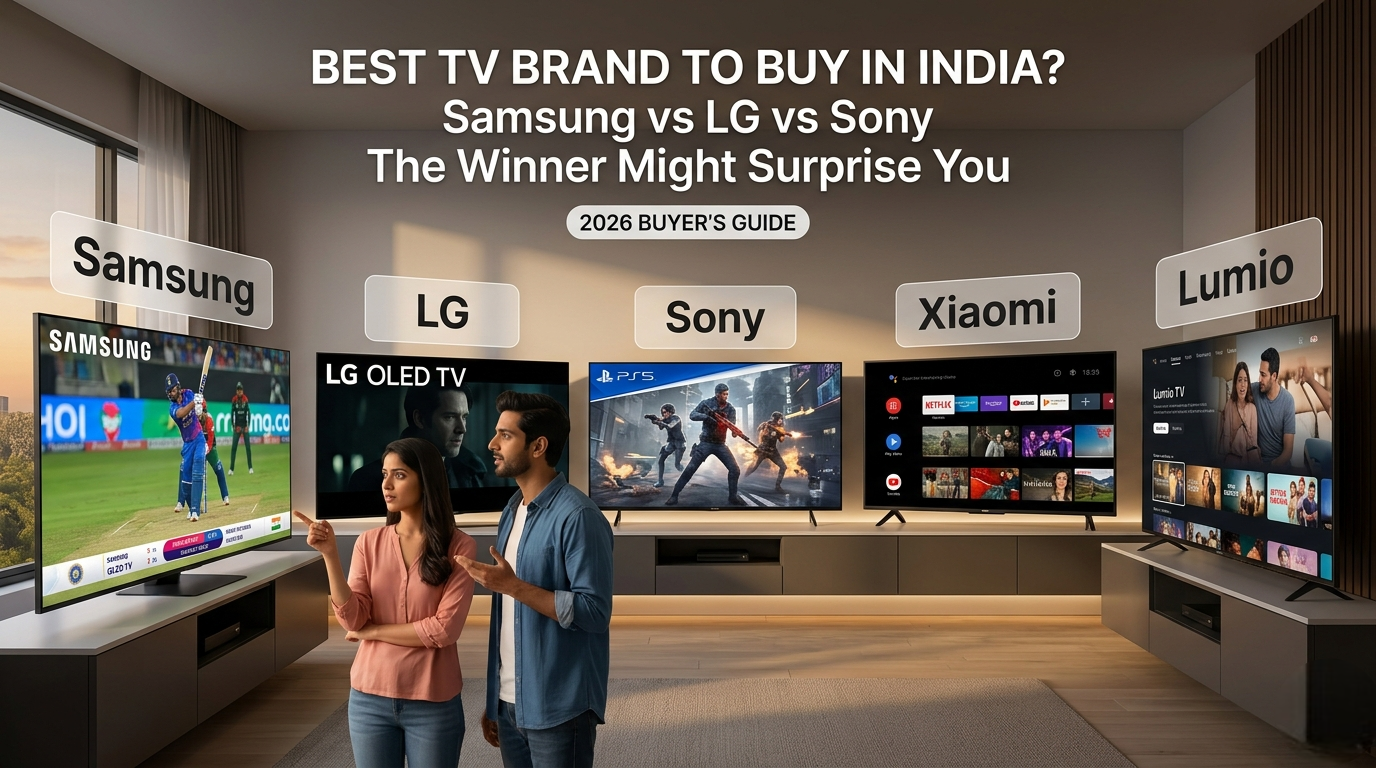
Buying a new TV in India is harder than ever because dozens of brands promise better picture quality, smarter features, and unbeatable prices. What many buyers don’t realize is that the best TV isn’t always the one with the longest feature list — the brand behind the panel often matters more than the panel itself. I’ve spent a lot of time digging through TV specs, watching demo footage, and listening to what people in various Indian cities actually say after living with these TVs for a year or two. And here’s the thing — picking the wrong TV brand in India doesn’t just mean a mediocre picture. It can mean waiting three weeks for a technician, watching your smart apps stop working after 18 months, or realizing that Disney+ Hotstar simply doesn’t run cleanly on the OS your TV shipped with. This guide compares the five brands I’d actually consider recommending — Samsung, LG, Sony, Xiaomi, and Lumio — and tries to be straight with you about who each one is really for.
Key Takeaways
- Samsung is the best overall TV brand in India for 2026 — widest model range, strongest service network, and a smart OS that doesn’t let you down mid-stream.
- LG OLED TVs produce the best picture quality you can buy in India right now, but you’re paying a serious premium for it — and that premium makes sense above ₹60,000.
- Sony Bravia TVs are purpose-built for PS5 owners and anyone who watches a lot of movies. The Cognitive Processor XR genuinely makes a visible difference.
- Xiaomi smart TVs are the go-to recommendation for anyone under ₹25,000. The specs-per-rupee ratio is hard to beat, and the Android TV integration is genuinely solid.
- Lumio is an Amazon-exclusive brand that makes sense only as a secondary TV — a bedroom set, a kids’ room screen, or a kitchen TV you don’t want to overthink.
- Before you buy anything, check for OTT app compatibility, BEE energy rating, service center proximity, and smart OS update history — these matter more long-term than peak brightness figures.
What Does “Best TV Brand in India” Actually Mean?
Honestly, it’s a harder question than it looks. If you search for “best TV brand to buy in India,” you’ll find a lot of lists that are basically repackaged global reviews with Indian rupee prices swapped in. But the reality of buying a TV in India is quite different from buying one in the US or Europe.
From what I’ve seen, three things tend to matter most once the novelty of a new TV wears off. First, after-sales service reach — and I mean this practically. If you’re in Nagpur or Coimbatore or Bhopal and your TV develops an issue, how fast can you get someone to look at it? For Samsung, the answer is usually pretty quick. For some of the newer brands, you might be waiting. Second, OTT platform compatibility — your TV’s smart OS must natively run Disney+ Hotstar, JioTV, ZEE5, and SonyLIV without requiring you to sideload APKs. This sounds like a small thing until you’re troubleshooting it at 9pm after a long day. Third, build quality relative to Indian conditions — voltage fluctuations are real in many parts of the country, and not all brands are built with that in mind.
So when I say “best TV brand,” I mean the one that consistently delivers a good picture, keeps its smart features working for years, and won’t leave you stranded when something goes wrong. That’s the framework I’ve used throughout this guide.
Why Your TV Brand Choice Matters More Than Any Single Model
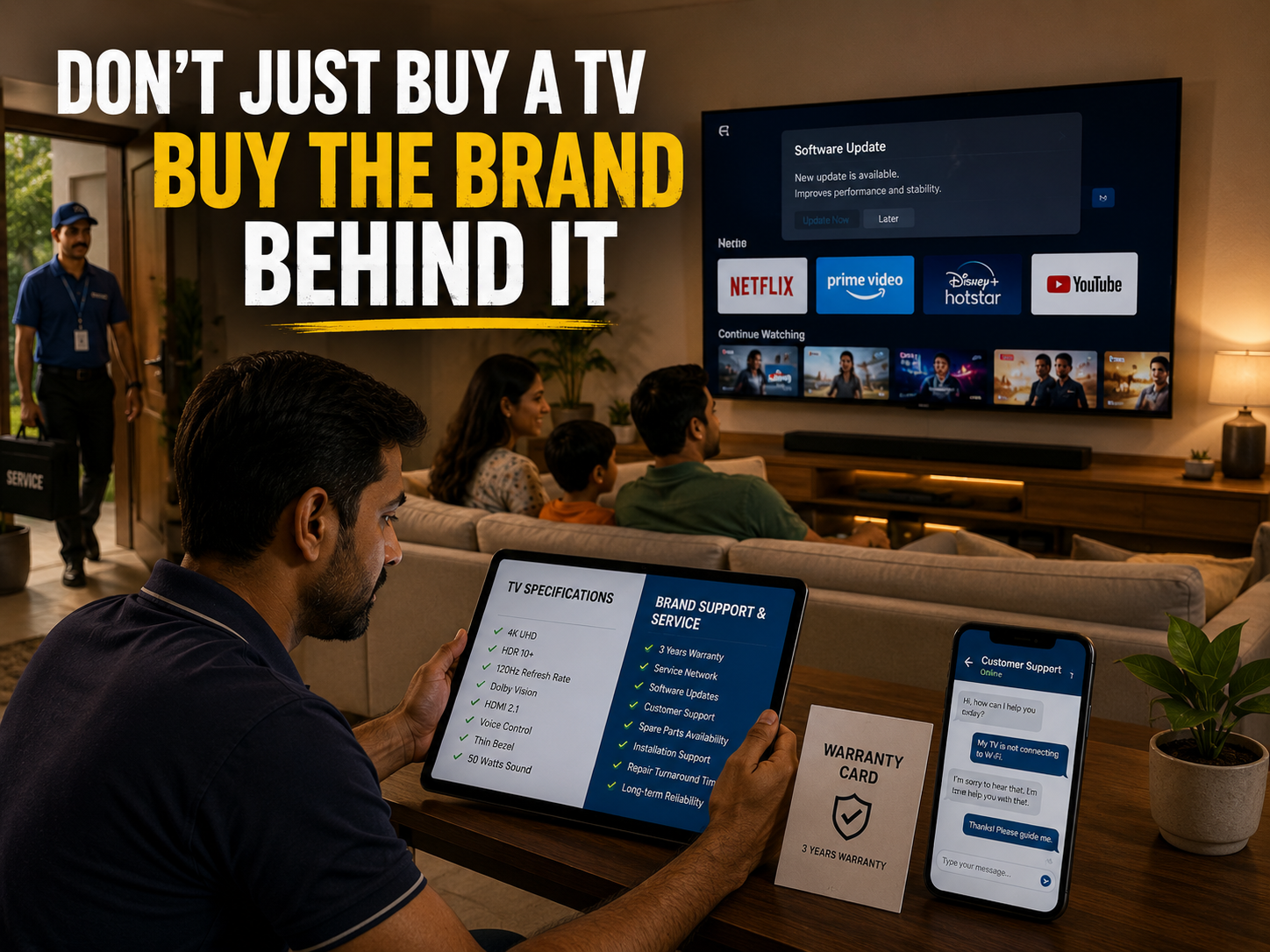
Here’s something worth sitting with: two TVs at the same price can look nearly identical at launch and diverge dramatically by year three. The gap almost always comes down to the brand behind the panel — not the panel itself.
Software updates are the clearest example. Samsung’s Tizen OS and LG’s webOS have multi-year update roadmaps. Some budget brands update their firmware twice and then quietly move on. Over time, streaming apps like Netflix and Prime Video push updates that require newer OS versions to run properly. A TV that felt snappy in 2024 can start stuttering by 2026 if the brand has stopped pushing updates. I’ve seen this happen first-hand.
📊 Stat: India’s smart TV market is projected to grow at a CAGR of around 12% between 2024 and 2029, driven largely by OTT adoption in Tier-2 and Tier-3 cities — Source: Mordor Intelligence, 2024. Yet buyer dissatisfaction surveys consistently point to software issues and slow service response, not display quality, as the top post-purchase complaints.
Service networks are the other underappreciated differentiator. Samsung, for instance, has authorized service centers in over 1,500 cities across India — which means if you’re in a mid-sized town, you’re likely covered. LG is strong in metro and Tier-1 cities but thins out beyond that. This isn’t a dealbreaker for everyone, but it’s worth knowing before you buy.
If you’re building a connected smart home, a quality television is only one piece of the puzzle. Many homeowners are also investing in AI-powered security cameras for Indian homes to monitor entrances, receive motion alerts, and manage home security from a single ecosystem.
Best TV Brand to Buy in India in 2026: Top 5 Reviewed
These five brands — Samsung, LG, Sony, Xiaomi, and Lumio — represent what I’d genuinely recommend depending on your budget and priorities. I’ve tried to be honest about what each brand gets wrong, not just what it gets right.
1. Samsung — Best Overall TV Brand in India
Samsung remains the safest, most comprehensive TV brand you can buy in India in 2026. It covers every price point from ₹15,000 LED TVs to ₹5 lakh Neo QLED flagships, and the quality is consistent across the range in a way that few brands can match.
The QLED and Neo QLED panels punch hard in bright Indian living rooms — and this matters more than people realize. OLED looks stunning in a dark home theatre, but most Indian living rooms aren’t dark. They’re sunny, open spaces where a high-brightness QLED will often look better in practice than a contrast-king OLED. Samsung’s Tizen OS is probably the most polished smart TV platform available in India — it loads fast, runs Indian OTT apps without issue, and gets meaningful software updates. I’ve used Tizen TVs from three years ago that still feel current, which isn’t something you can say about every brand.
The service network is genuinely unmatched. If I had to recommend a single brand to a friend buying their first TV in a non-metro city, Samsung is where I’d start.
Strengths:
- Broadest model range — ₹15K to ₹5L
- Tizen OS: fast, stable, long update support
- 1,500+ authorized service centers across India
- QLED panels ideal for bright living rooms
Weaknesses:
- Mid-range models can feel overpriced vs Xiaomi
- No OLED option (by design, but some buyers want it)
Ideal for: Most Indian buyers — especially first-time smart TV buyers, families, and anyone in a non-metro city where service coverage matters.
2. LG — Best for Picture Quality
If picture quality is the single most important thing to you — and you have the budget for it — LG OLED is the answer. There’s no debate here, honestly. OLED panels light each pixel individually, which means true blacks, infinite contrast, and colour accuracy that LED-based displays simply can’t replicate. Watch a dark cinematic scene on an LG OLED and then on a comparable QLED and you’ll see it immediately.
LG’s webOS is the other reason I’d recommend this brand. It’s genuinely one of the nicest smart TV interfaces to use day-to-day — clean, fast, and well-organized. The ThinQ AI features work better than I expected too, particularly for voice control in an Indian English accent, which is often an issue with voice assistants.
The honest caveat: LG’s service network is strong in metros but noticeably thinner in smaller cities. If you’re in Mumbai, Delhi, Bengaluru, or Hyderabad, you’re probably fine. If you’re in a smaller city, it’s worth checking service center availability before you commit.
Strengths:
- Best OLED picture quality available in India
- webOS is polished and responsive
- QNED and NanoCell ranges for mid-budget buyers
Weaknesses:
- OLED pricing is a significant jump
- Service network thins out beyond major metros
Ideal for: Home theatre setups, dedicated movie rooms, and buyers with ₹60,000+ who watch a lot of OTT content in lower-light environments.
3. Sony — Best for Gamers and Movie Lovers
Sony Bravia TVs do something the other brands don’t quite replicate: they process picture and sound together. The Cognitive Processor XR doesn’t just upscale an image — it analyses it the way human perception works, cross-referencing brightness, focus, colour, and sound simultaneously. Whether that translates to a visible difference in real use? Honestly, yes. Particularly on movie content, the motion handling and depth feel a notch above what you’d expect.
For PlayStation 5 owners, the case for Sony is even clearer. The PS5-to-Bravia pipeline — HDMI 2.1, Auto HDR Tone Mapping, ALLM, near-instant input lag modes — is optimized in a way that no other TV brand has matched. If you own a PS5 and are choosing your next TV, this is the answer.
📊 Stat: India’s gaming market crossed $3.8 billion in 2024, with console gaming growing significantly in urban households — Source: KPMG India, 2024. That shift is driving strong demand for TVs with low input lag and HDMI 2.1 support, an area where Sony leads.
The trade-off is price. Sony typically charges a premium over Samsung at equivalent spec levels — you’re paying for processing intelligence, build quality, and the PlayStation ecosystem. That premium is worth it for the right buyer. For casual viewers on a tight budget, it probably isn’t.
Strengths:
- Cognitive Processor XR — genuinely noticeable
- PS5-optimized with HDMI 2.1, VRR, ALLM
- Google TV with every Indian OTT app
Weaknesses:
- Higher price-per-spec vs Samsung in the same range
- Limited options under ₹30,000
Ideal for: PS5 owners, heavy OTT users who watch lots of films, and buyers willing to pay for perceptibly better audio-visual processing.
4. Xiaomi — Best Budget TV Brand in India
Xiaomi is, without question, the best value-for-money TV brand in India in 2026. It’s not a close contest in the sub-₹25,000 bracket. You’re getting 4K resolution, Dolby Vision, Android TV with Chromecast built-in, and a decent panel — at a price that Samsung and LG can’t touch without compromising significantly on specs.
From what I’ve seen, Xiaomi’s Mi service network has improved a lot over the last few years. It used to be a genuine weakness — and if you’re in a smaller town, it can still be inconsistent. But in most Tier-1 and major Tier-2 cities, getting service scheduled is much more straightforward than it was even two years ago.
📊 Stat: Xiaomi held approximately 18% of India’s TV market share by volume in 2024, making it the top-selling brand by units in the budget segment — Source: IDC India, 2024. That level of market penetration has also helped build out the Mi service and parts ecosystem significantly.
One genuine criticism: the build at the lowest price points can feel a little plasticky. The remote on some models is underwhelming. These are real trade-offs, not nitpicks — but for most buyers under ₹25,000, they’re acceptable trade-offs given what else you’re getting for the money.
Strengths:
- Best specs-per-rupee ratio in India
- Android TV + Chromecast built-in
- Dolby Vision at genuinely budget prices
Weaknesses:
- Plasticky build at entry-level price points
- Service response varies significantly by city
Ideal for: First-time smart TV buyers, budget-conscious buyers under ₹25,000, and young households setting up their first living room TV.
5. Lumio — Best Entry-Level Option on Amazon India
I’ll be straight with you: Lumio isn’t a brand I’d recommend as your primary living room TV. But for what it is — an Amazon-exclusive entry-level brand at the lowest price point in the market — it does the job it’s designed for reasonably well.
Think of Lumio as the option for a guest room, a children’s room, or a kitchen TV where you just need something that turns on, streams decently, and doesn’t require much thought. The Amazon-backed warranty and straightforward return policy remove a lot of the risk, which genuinely matters at this price point. And prices drop further during Amazon sales events, which happen several times a year.
What it isn’t: a replacement for a brand with a real service network, long-term software support, or a premium panel. Don’t buy it expecting those things.
Strengths:
- Lowest price point on Amazon.in
- Amazon warranty and return policy reduces risk
- Functional smart features for basic streaming
Weaknesses:
- No dedicated service center network
- Limited panel quality and long-term software support
Ideal for: Secondary TVs — guest rooms, kids’ rooms, kitchens. Buyers under ₹15,000 who want a no-risk, no-frills smart screen.
Head-to-Head Comparison: Samsung vs LG vs Sony vs Xiaomi vs Lumio
| Brand | Price Range | Panel Tech | Smart OS | Service Network | Best For | Rating |
|---|---|---|---|---|---|---|
| Samsung | ₹15K–₹5L | LED, QLED, Neo QLED | Tizen | Best all-round pick | ||
| LG | ₹25K–₹4L | LED, QNED, OLED | webOS | Picture quality first | ||
| Sony | ₹30K–₹5L | LED, OLED | Google TV | Gaming & Cinema | ||
| Xiaomi | ₹12K–₹80K | LED, QLED | Android TV | Budget buyers | ||
| Lumio | ₹8K–₹25K | LED | Android-based | Entry-level / Secondary |
Which TV Brand Should You Buy Based on Your Budget in India?
Budget Tier — Under ₹25,000: Go with Xiaomi X or A Series — it’s not even close. If you’re under ₹15,000 and need a secondary screen, Lumio is worth considering via Amazon.
Mid-Range Tier — ₹25,000–₹60,000: This is Samsung’s sweet spot — Crystal 4K or QLED. If you want better colour accuracy and are willing to pay slightly more, the LG NanoCell range is worth a look.
Premium Tier — Above ₹60,000: LG OLED C Series for pure picture quality. Sony Bravia if you own a PS5 or prioritize audio-visual processing. Both are excellent — this comes down to use case.
What to Look for When Buying a TV in India — A Practical Checklist
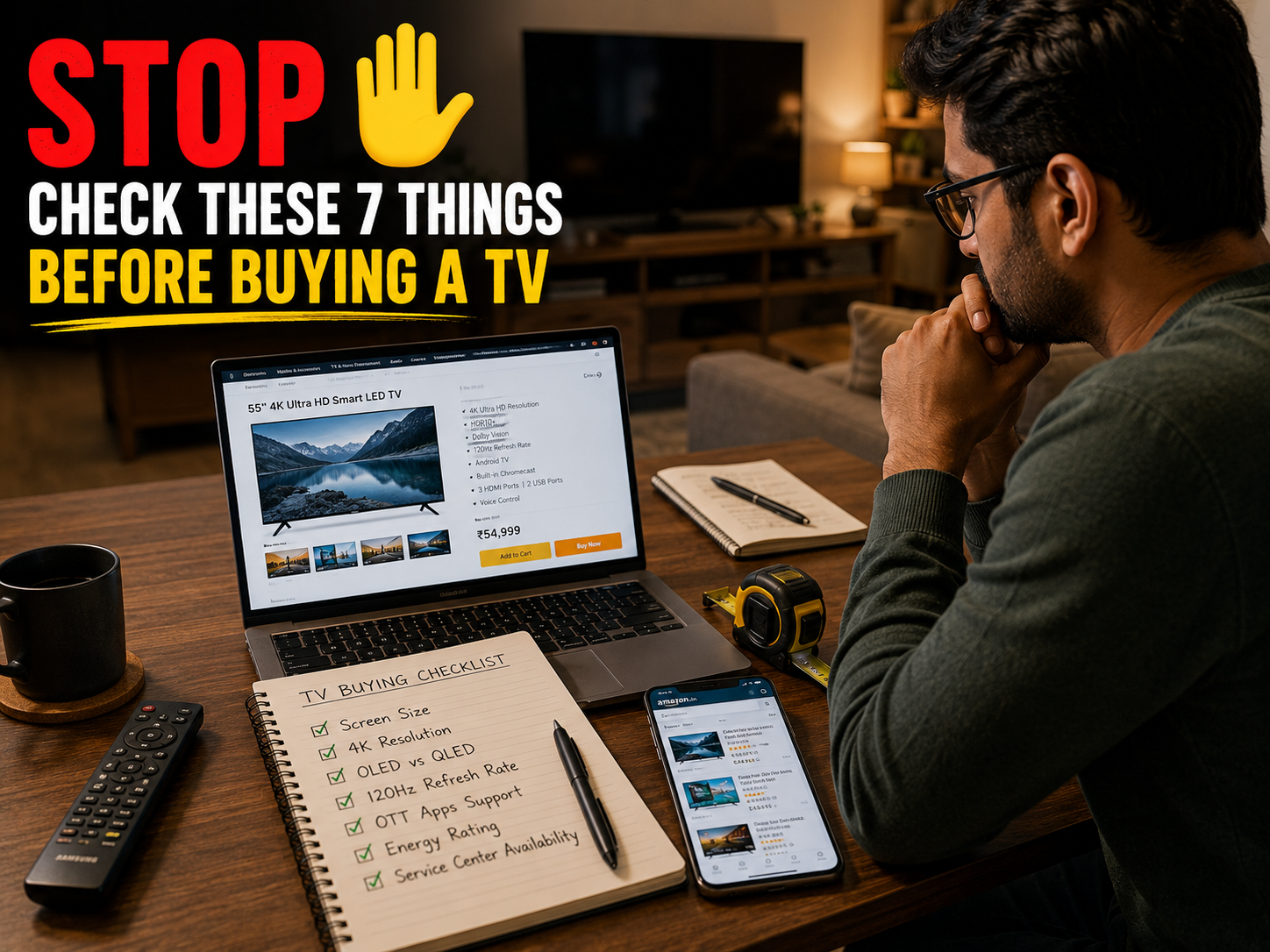
Most global TV buying guides don’t account for India-specific realities. Here are seven things I’d check before finalizing any brand or model:
- Screen Size vs Viewing Distance — A quick rule of thumb that actually works: take your viewing distance in inches and divide by 1.5. For a 10-foot room (120 inches), that’s an 80-inch TV in theory — but most people land happily at 55 inches. Don’t buy bigger just because it’s on sale.
- Panel Type for Your Room — OLED excels in dim, controlled lighting. QLED handles bright, sunlit rooms better. Don’t spend OLED money if your living room gets afternoon sun blasting through uncovered windows — you won’t see the difference that justifies the cost.
- Resolution — 4K is the minimum for anything 43 inches and above in 2026. Full HD is fine for compact bedroom TVs under 40 inches. Don’t let anyone sell you 8K right now — there’s barely any 8K content and the price uplift is enormous.
- Smart OS and OTT App Native Support — Before buying, check that Disney+ Hotstar, JioTV, ZEE5, and SonyLIV are natively available on the TV’s app store. Some OS versions require sideloading, and sideloaded apps tend to be unstable and slow.
- Refresh Rate — 60Hz is fine for general TV viewing. If you watch a lot of cricket, football, or play games, pay the extra for 120Hz — motion blur reduction is genuinely noticeable on fast content.
- BEE Energy Star Rating — This is probably the most overlooked factor. A 5-star BEE-rated TV saves between ₹2,000 and ₹5,000 per year on electricity bills compared to a 1-star equivalent of the same size. Over five years, that’s a real chunk of money.
- Service Center Availability in Your City — Before you finalize any brand, Google “[Brand name] service center [your city]” and actually verify a center exists. Samsung is safe almost everywhere. LG is safe in major cities. Others — check first.
Is Buying a TV on Amazon India Worth It Compared to a Local Electronics Store?
For the vast majority of buyers, yes — Amazon.in is the better option, and not just because of price. The honest reason is the 10-day return policy. Most local electronics stores will offer an exchange if something is obviously defective, but Amazon’s policy is more generous and more consistently enforced. That matters when you’re spending ₹40,000 or more on a screen.
No-Cost EMI availability is another genuine advantage. Most major models from Samsung, LG, Sony, and Xiaomi are available on no-cost EMI through major bank cards — which means you’re not paying extra to spread the cost. Local stores offer EMI too, but the terms are often less transparent.
📊 Stat: Amazon India’s Great Indian Festival (October) and Prime Day (July) consistently deliver 20–35% discounts on premium TV brands — Source: Amazon India Historical Sale Data, 2023–2025. If your purchase isn’t urgent, timing it for one of these events can save you several thousand rupees on mid-range and premium models.
The one scenario where a local store makes more sense: if you need installation support, want to negotiate on accessories, or prefer seeing the TV in person before buying. Flagship Samsung or Sony stores in major cities often have excellent demo setups worth visiting before committing.
Conclusion — My Final Verdict on the Best TV Brand in India for 2026
If someone asked me to pick a single best TV brand to buy in India in 2026 for most households, I’d say Samsung — not because it’s the flashiest option, but because it’s the most consistently good one across budgets, service coverage, and software longevity. For buyers under ₹25,000, Xiaomi wins without much debate. At the premium end, LG OLED produces picture quality that nothing else in India matches, while Sony Bravia is the clear choice for PS5 owners and serious movie watchers. Lumio earns its place for buyers who need a low-risk secondary TV on a tight budget.
Whatever you decide, buy from Amazon India for the combination of price, EMI flexibility, and return policy. And if there’s one thing to take from this entire guide: check your city’s service center coverage before you commit. That single step will save a lot of headaches down the line.
If you’re upgrading your living room this year, it may also be worth exploring our guides to the best smart lighting systems for home entertainment to complete your smart home setup.
Frequently Asked Questions
FAQ 1: Which TV brands are most reliable for purchase in India?
Samsung, LG, and Sony are consistently the most reliable TV brands available in India, supported by decades of market presence, widespread authorized service networks, and long software update cycles. Xiaomi has built genuine reliability credentials in the budget segment over the last five years, particularly in major cities where Mi service coverage is good. Lumio, as a newer Amazon-exclusive brand, is best treated as a low-risk secondary TV option rather than a reliability benchmark.
FAQ 2: Which TV manufacturers offer the best after-sales customer service in India?
Samsung leads on after-sales service in India, with authorized centers in over 1,500 cities — making it the safest choice for buyers in non-metro locations. LG is excellent in metro and Tier-1 cities, though coverage thins beyond that. Sony maintains a strong urban service network. Xiaomi’s Mi service centers cover most major cities and have improved significantly over recent years. Lumio’s service support runs primarily through Amazon’s return and replacement program rather than a dedicated center network.
FAQ 3: Where can I find trustworthy reviews of TV brands sold in India?
For practical Indian-context reviews, I’d look at Amazon.in verified purchase reviews first — they reflect real-world usage, including service experiences. YouTube channels like Technical Guruji, Geekyranjit, and GadgetsIndia do solid hands-on testing. Tech publications like 91mobiles, Digit, and NDTV Gadgets 360 cover most major model launches in detail. For community feedback, forums like Reddit’s r/IndiaInvestments and tech threads often surface real owner experiences that review sites miss.
FAQ 4: Which is the best TV brand to buy in India in 2026?
Samsung is the best overall TV brand to buy in India in 2026, offering the strongest combination of model variety, picture quality (QLED and Neo QLED), smart OS reliability (Tizen), and after-sales coverage across Indian cities. For budget buyers under ₹25,000, Xiaomi is the better choice. For premium picture quality above ₹60,000, LG OLED leads. For gamers and cinephiles, Sony Bravia with its Cognitive Processor XR and PS5 optimization makes a compelling case.
FAQ 5: What should I prioritize when buying a TV in India?
In India specifically, prioritize: (1) Smart OS native OTT support — confirm Disney+ Hotstar, JioTV, ZEE5, and SonyLIV run natively; (2) Panel type matched to your room’s lighting — OLED for dim rooms, QLED for bright living rooms; (3) 4K resolution for any screen 43 inches and above; (4) BEE 5-star energy rating, which saves ₹2,000–5,000 annually on electricity; (5) Service center proximity in your city — verify before you buy; and (6) Refresh rate — 120Hz for sports viewers and gamers. After-sales service availability is the factor most buyers underweight and most regret ignoring.
Written by Kunal Mehta: Kunal Mehta is a technology content writer focused on consumer electronics, digital products, and buying guides. His work covers a wide range of everyday technology products, helping readers understand key features, compare options, and make informed purchasing decisions.
Affiliate Disclosure: This article contains affiliate links. If you make a purchase through these links, we may earn a small commission at no additional cost to you. This helps support our editorial work and ongoing content research. Our recommendations are based on independent research, product analysis, and publicly available information.
Disclaimer: This article is based on product research, market analysis, manufacturer specifications, customer feedback, and publicly available information regarding televisions and home entertainment products available in India. Features, pricing, availability, software updates, warranty terms, and smart TV capabilities may change over time depending on manufacturers and retailers. Readers are encouraged to verify the latest specifications, pricing, and compatibility details before making a purchase decision. This content was initially drafted with AI assistance and has been carefully reviewed, refined, and fact-checked by human editors to ensure accuracy, clarity, originality, and practical value for readers.