Top 10 Water Purifier for Home in India: Best RO, UV & UF Picks
By Vivek Arora | Technology Content Writer
Summarize this blog post with: ChatGPT | Perplexity | Claude | Grok
If you’ve spent any time researching water purifiers for your home, you’ve probably noticed something frustrating: every “Top 10” list looks the same, and none of them ask the one question that actually matters — what’s in your water. I’ve gone down this rabbit hole myself, and here’s the honest truth: the best water purifier for your home in India isn’t the one with the most filtration stages or the flashiest marketing copy. It’s the one that matches your actual water source. This guide walks you through ten solid options on Amazon.in, explains the technology in plain language, and — more importantly — helps you figure out which one you actually need.
Key Takeaways
- Water purifiers use different technologies — RO, UV, UF, and activated carbon — and each one solves a different water-quality problem, not all problems at once.
- RO purifiers matter most when TDS is high (generally above 300 ppm), which is common in borewell or tanker water across much of India.
- Low-TDS municipal water often doesn’t need RO at all — a UV or UF system can do the job without wasting water.
- The Bureau of Indian Standards requires RO purifiers to meet a minimum 40% water recovery rate — Source: Bureau of Indian Standards, IS 16240:2023.
- A 6–8 litre storage tank is usually enough for a family of four to five people.
- The purchase price is only part of the cost — filters, servicing, and water wastage add up over a purifier’s lifetime.
- A basic TDS meter (under ₹500 on Amazon) tells you more than any online review ever will.
What Is a Water Purifier, Really?
A water purifier is a home appliance built to reduce specific contaminants — bacteria, viruses, heavy metals, dissolved salts, or suspended particles — before you drink the water. That’s the textbook definition, but in practice, no single purifier does everything. Each technology is built to solve a particular kind of problem, which is exactly why picking “the best-rated one” without knowing your water source rarely works out well.
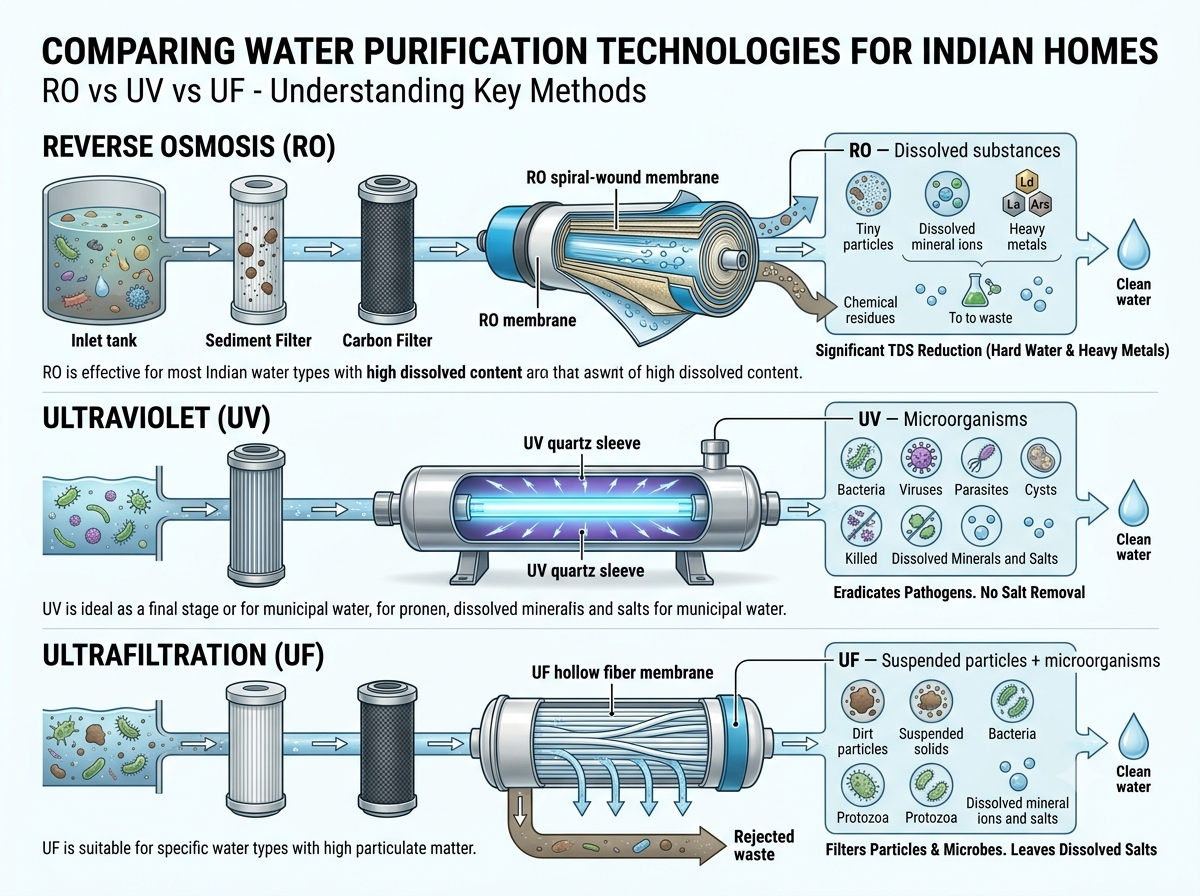
Reverse Osmosis (RO) forces water through a semi-permeable membrane fine enough to block dissolved salts and heavy metals — stuff you can’t see, taste, or filter out with a basic carbon block. If your borewell water tests high for fluoride or has that faint metallic taste, RO is usually the only technology that actually fixes it.
UV purification works differently. It uses ultraviolet light to kill bacteria and viruses, but it does nothing for dissolved solids. This makes it a good match for municipal water that’s already low in TDS but might carry contamination during monsoon season, when supply lines sometimes get compromised.
Ultrafiltration (UF) physically strains out suspended particles and larger microorganisms through a membrane — no electricity required. It’s a nice fit for gravity-fed setups or areas with frequent power cuts.
Most mid-range purifiers sold today combine RO, UV, and UF into one unit, and honestly, that’s become the default for a reason — most Indian households deal with mixed water quality issues rather than just one problem. The Bureau of Indian Standards has a specific quality benchmark for these systems under IS 16240:2023, which requires RO-based point-of-use purifiers to meet minimum recovery and performance standards — Source: Bureau of Indian Standards, 2023.
Why Does This Even Matter for Indian Homes?
Here’s the thing — a lot of people buy a purifier because their neighbor has one, or because an ad convinced them it’s necessary. But water quality genuinely varies block to block, let alone city to city. Groundwater in several Indian regions shows elevated fluoride, nitrate, or salinity levels well above safe limits — Source: Central Ground Water Board, 2025. If you’re on a borewell connection, this isn’t a hypothetical concern; it’s the reason your kettle scales up faster than it should.
That said, not every water-quality issue needs an RO system. The Central Pollution Control Board has actually cautioned against installing RO purifiers indiscriminately, pointing to the 500 mg/L TDS threshold under IS 10500:2012 as the relevant benchmark for when RO purification is genuinely warranted — Source: Central Pollution Control Board, 2018. In plain terms: if your water’s TDS is well under that number, an RO purifier might be solving a problem you don’t have, while wasting water and stripping out minerals your body actually needs.
Waterborne illness also remains a real concern in areas with inconsistent municipal treatment. A household on borewell water above 500 ppm TDS will often notice a salty taste, kettle scaling, or mild digestive discomfort — small signals that purification is overdue, even if nothing looks obviously wrong.
Which Water Purifier Technology Is Actually Right for You: RO, UV, or UF?
This is the question that trips up most first-time buyers, and understandably so — the marketing rarely explains it clearly.
How Do I Know If I Need an RO Purifier?
Your decision should hinge mostly on your water’s TDS (Total Dissolved Solids) — the concentration of dissolved minerals and salts, measured in parts per million (ppm). Water below roughly 200 ppm is generally fine with UV or UF treatment alone. Cross 300 ppm, and RO becomes the more sensible choice, since UV and UF simply don’t remove dissolved salts.
Municipal water in most Indian metros typically falls in the 50–300 ppm range, while borewell water frequently crosses 300–800 ppm depending on the region. If your reading lands in that 200–300 ppm gray zone, honestly, it comes down to personal taste preference and budget more than hard science — both technologies can reasonably work there.
TDS alone isn’t a complete safety test, though. It tells you concentration, not composition. The BIS drinking-water specification (IS 10500:2012) covers a much wider set of parameters — microbiological, chemical, and physical — that TDS numbers alone can’t capture. If you’re genuinely worried about contamination beyond dissolved solids, a lab test or your local water board’s report gives a more complete picture than a ₹300 meter ever will.
Is RO Water Purification Wasteful?
Yes, and this is worth knowing before you buy one. Standard RO purifiers typically waste around three litres of water for every litre they purify — a real concern if you live somewhere like Chennai or Bengaluru where water is scarce and, increasingly, expensive. Newer water-saver models have pushed recovery rates much higher, cutting that wastage closer to a near 1:1 ratio. If sustainability or your water bill is a concern, it’s worth paying a bit more for a purifier built around this.
Top 10 Water Purifiers for Home in India (Amazon.in)
I’ve tried to keep this list practical — a mix of budget, mid-range, and premium picks, each suited to a different water situation. Prices and exact specs on Amazon shift constantly, so treat these as starting points and always double-check the current listing before you buy.
- KENT Grand Plus RO+UV+UF — Still India’s best-selling RO purifier for good reason. Works across borewell, tanker, and municipal water, with an 8L tank and a TDS controller that retains some natural minerals.
- Aquaguard Marvel NXT (Eureka Forbes) — RO+UV with Mineral Guard Technology and a filter-health indicator that actually tells you when service is due, which is more useful in daily life than it sounds. Good for families of 3–5.
- Havells Aquas Pro — Mid-range RO+UV+UF with copper and zinc enrichment, plus a filter-monitoring system. Solid pick if you want a recognizable appliance brand.
- Aquaguard Delight NXT Aquasaver — This one’s built specifically around water conservation, with Amazon’s listing claiming up to 60% water savings over conventional RO units, and it’s rated for municipal, borewell, and tanker sources. Its filter cartridge is rated for roughly 6,000 litres or a year under standard conditions — Source: Amazon.in product listing, accessed 2026.
- Pureit Eco Water Saver (HUL) — Another water-conservation-focused option, wasting significantly less than standard RO systems, which matters if you’re in a water-stressed city.
- Livpure GLO PRO++ — A value-for-money RO+UV+UF pick that’s popular with smaller households and tighter budgets.
- KENT Supreme Extra — Built for high-TDS borewell or municipal water, with an 8L tank and a 20 L/hr flow rate that handles multiple people needing water through the day.
- Havells Aquas Lite (UV+UF) — A genuinely good budget pick if your municipal water tests low on TDS — no RO needed, no water wasted.
- AO Smith X2 (UV+UF) — Rated for water up to around 200 ppm TDS, with a compact 5L tank. Worth considering if you’ve tested your water and know RO isn’t necessary.
- V-Guard Zenora (RO+UF) — A value-focused 7L option that doesn’t get talked about as much as the bigger brands but holds its own on core purification.
Comparison Table
| Purifier | Technology | Approx. Storage | Best For |
|---|---|---|---|
| KENT Grand Plus | RO+UV+UF | 8L | All water sources, large families |
| Aquaguard Marvel NXT | RO+UV | 7L | Borewell water, filter-health alerts |
| Havells Aquas Pro | RO+UV+UF | 7L | Mid-range, mineral enrichment |
| Aquaguard Delight NXT Aquasaver | RO+UV+UF | 6.2L | Mixed water sources, water-saving |
| Pureit Eco Water Saver | RO | Varies | Water-scarce cities, low wastage |
| Livpure GLO PRO++ | RO+UV+UF | Varies | Budget-conscious buyers |
| KENT Supreme Extra | RO | 8L | High-TDS borewell water |
| Havells Aquas Lite | UV+UF | Varies | Low-TDS municipal water |
| AO Smith X2 | UV+UF | 5L | Water under 200 ppm TDS |
| V-Guard Zenora | RO+UF | 7L | Value-focused core purification |
What Does It Actually Cost to Maintain a Water Purifier Every Year?
This is the part people underestimate. Annual maintenance — filter replacement, cartridge changes, occasional servicing — typically runs somewhere between ₹1,500 and ₹4,000 depending on the technology and brand. An RO+UV+UF system will generally cost more to run than a UV-only unit simply because there are more stages to replace.
From what I’ve seen, buyers get fixated on the upfront price and forget to check what a replacement filter costs a year later. A purifier that’s ₹2,000 cheaper on Amazon can end up costing more over three years if its filters are proprietary and pricey. It’s worth doing that math before you check out, not after.
Which Purifier Features Are Actually Worth Paying For?
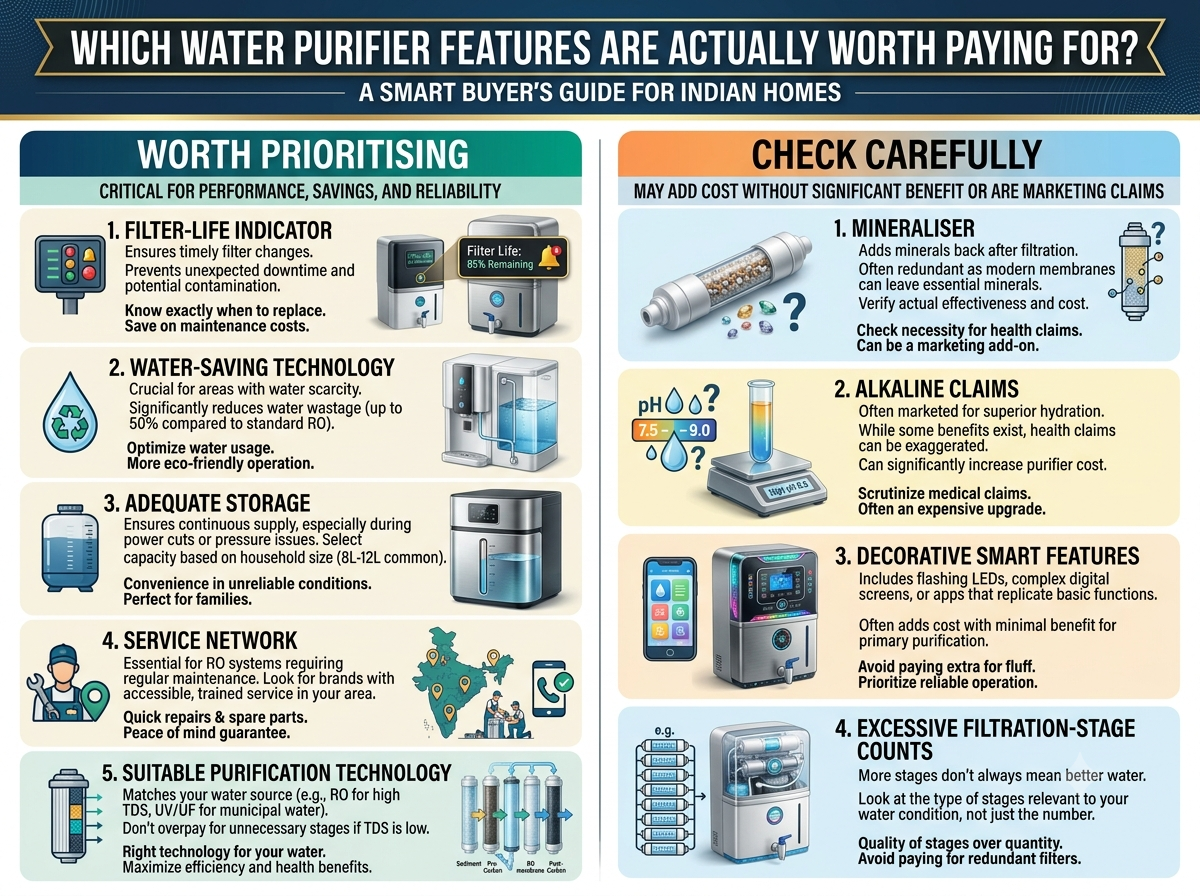
Not every advertised feature is worth the premium. A few genuinely make a difference in daily use, and a few are mostly marketing:
- Filter-life indicators — genuinely useful; saves you from drinking through an expired filter.
- Water-saving RO technology — worth it if you’re paying for water or live somewhere water-scarce.
- TDS controllers/mineralisation — nice to have for taste, but treat it as a bonus feature, not a health necessity.
- Adequate storage matched to family size — more practically important than most people realize, especially with variable power supply.
- Local service network coverage — arguably more important than the brand name itself. A great purifier with no nearby service center becomes a headache fast.
What Should You Check Before Buying on Amazon.in?
Before you add anything to cart, run through this:
- Identify your actual water source — municipal, borewell, tanker, or a mix.
- Test TDS with a basic meter; use it as one data point, not the whole picture.
- Match the technology (RO, UV, UF, or hybrid) to what your water actually needs.
- Calculate storage based on family size — 6–8L covers most households.
- Check filter replacement costs before you get attached to a low sticker price.
- Confirm installation and service availability in your city or apartment complex.
- Verify the current Amazon.in listing — seller, warranty, and specs can shift often.
- For RO systems, compare water-recovery rates if sustainability matters to you.
What’s Next: How Do You Actually Finalize Your Purchase?
Start with your water, not the product listing. If you’re on borewell or tanker water, shortlist RO-based systems first. If you’re on treated municipal water with a decent TDS reading, don’t rule out a UV/UF-only system — it’ll save you money and water in the long run.
Once you’ve got two or three models narrowed down, compare them side by side on filter cost, service reach, storage, and current price — not just star ratings, which can be misleading and are often skewed by early reviews before long-term ownership issues show up.
Conclusion
The best water purifier for your home in India isn’t the one with the longest spec sheet or the highest price tag — it’s the one that actually matches what’s coming out of your tap. Whether that’s the fully-loaded KENT Grand Plus for a borewell-fed household or a simple UV+UF unit like the AO Smith X2 for low-TDS municipal water, the right choice comes down to testing your water first and shopping second. Clean water is one of those quiet, unglamorous investments that pays off in ways you won’t always notice immediately — fewer stomach issues, less scaling, better peace of mind. Test your TDS, be honest about your budget, and pick accordingly.
If a water purifier is just one item on your home-upgrade list this year, our guide to the best smart lighting system for home in India covers the same kind of real-world pricing and buying advice for your next appliance decision.
Frequently Asked Questions
FAQ 1: Is RO water purifier necessary for municipal water?
Not always. If your municipal water tests below roughly 200 ppm TDS, a UV or UF purifier is often sufficient and avoids the water wastage that comes with RO systems.
FAQ 2: How often should I change my water purifier filter?
Most manufacturers recommend replacement every 6–12 months or after a specific volume of water passes through, whichever comes first — check your specific model’s listing for exact figures.
FAQ 3: Can I install a water purifier myself, or do I need a technician?
Most RO and UV+UF purifiers require professional installation for proper plumbing connection and calibration; most brands include free installation with purchase, but it’s worth confirming before you buy.
FAQ 4: Does RO water remove essential minerals from drinking water?
Yes, standard RO does strip most dissolved minerals along with contaminants, which is why many modern purifiers include a mineraliser or TDS controller to add some minerals back.
FAQ 5: What’s the ideal storage capacity for a family of four?
A 6–8 litre tank generally covers a household of four to five comfortably, though homes with frequent power cuts may want to size up slightly for buffer.
FAQ 6: How do I check my home’s water TDS level?
A handheld TDS meter, available on Amazon for under ₹500, gives an instant ppm reading and is the quickest way to decide whether you need RO or a simpler UV/UF system.
Author & Editorial Information
Written by Vivek Arora: Vivek Arora is a technology and consumer electronics content writer covering home appliances, smart home products, and everyday technology for Indian consumers. His work focuses on explaining technical specifications, practical features, and buying factors in a clear and easy-to-understand way.
Reviewed by: Smart Home Product Specialists & Technology Content Editors.
Affiliate Disclosure: This post may contain affiliate links. If you purchase a product through these links, we may earn a small commission at no additional cost to you. Our recommendations are based on product research, manufacturer information, available market data, and practical buying considerations.
Disclaimer: This article is based on publicly available product information, manufacturer specifications, market research, and general evaluation of water purifiers available in India. Water quality, filtration performance, filter life, pricing, availability, warranty coverage, installation requirements, and features may vary by model and location. Readers should check the latest specifications, purification technology, service availability, warranty terms, and pricing before making a purchase decision. This content was initially drafted with AI assistance and has been reviewed, edited, refined, and fact-checked by human editors to improve accuracy, clarity, originality, and practical relevance.