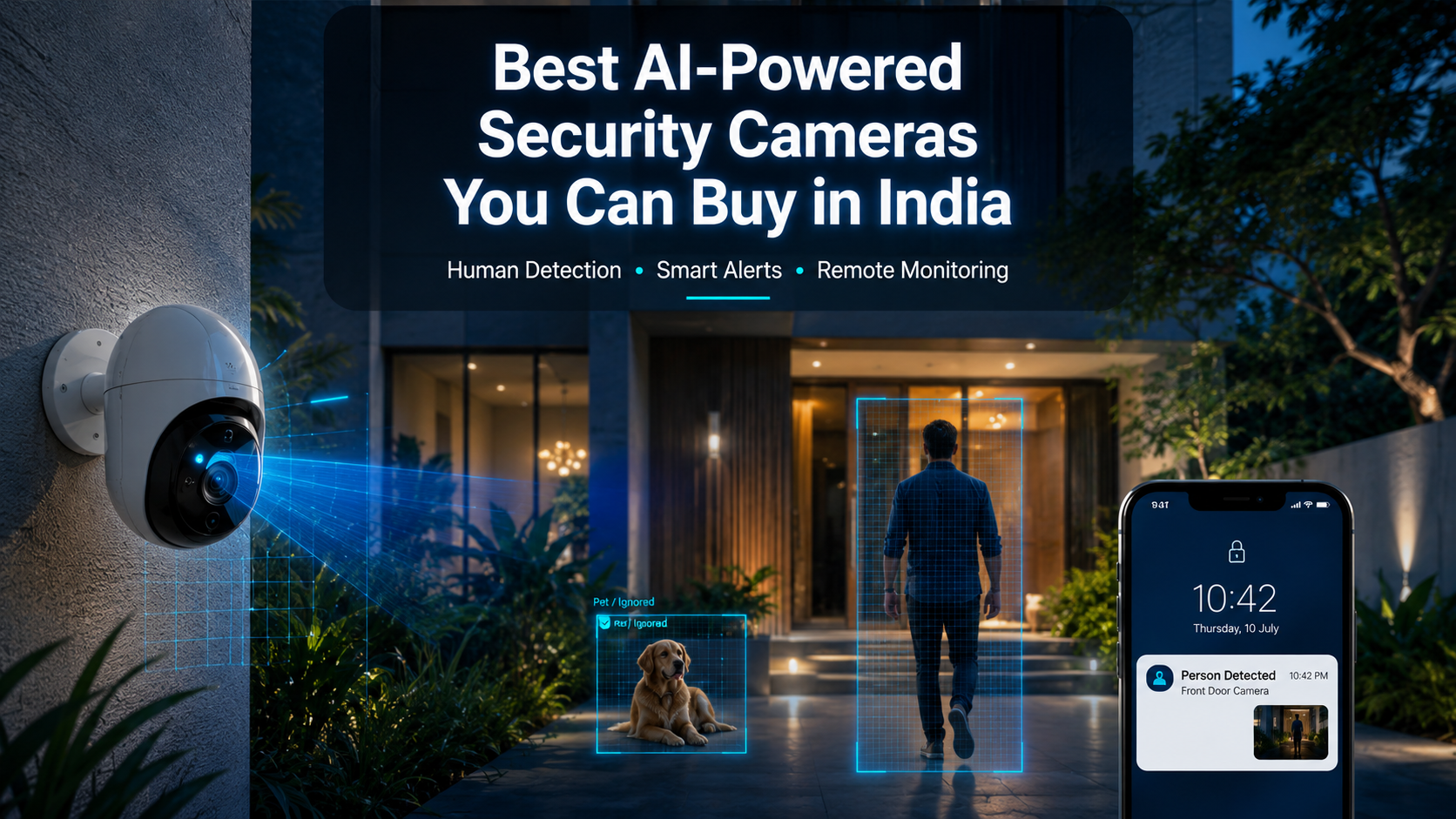
Best AI-Powered Security Cameras You Can Buy in India
By Rahul Kapoor | Consumer Tech Writer
Summarize this blog post with: ChatGPT | Perplexity | Claude | Grok
A few years ago, buying a security camera was simple. You installed a CCTV camera, connected it to a DVR, and hoped you never had to check the footage.
Today, that’s no longer enough.
Most people don’t want to scroll through hours of recordings just to figure out whether someone was actually at their door. They want a camera that can recognize a person, ignore the neighborhood cat, and send a useful notification when something important happens.
That’s exactly why AI-powered security cameras have become one of the fastest-growing categories in smart home security. In this guide, I’ll walk you through the best AI-powered security cameras you can buy in India right now, explain which AI features genuinely matter, and help you avoid spending money on features you’ll probably never use.
Key Takeaways
- AI-powered security cameras use machine learning to identify people, vehicles, pets, and unusual activity more accurately than traditional CCTV systems.
- Human detection technology significantly reduces false alerts caused by shadows, insects, rain, and moving objects.
- Smart CCTV cameras provide real-time notifications, remote monitoring, and intelligent event recording through mobile apps.
- AI home security systems help users focus on important events instead of reviewing hours of unnecessary footage.
- Night vision quality, AI detection accuracy, storage options, and app performance are often more important than resolution alone.
- Different AI cameras are optimized for apartments, homes, offices, shops, elderly monitoring, and pet surveillance.
- Choosing a camera based on your actual security needs usually delivers better results than buying the most expensive model available.
What Is an AI-Powered Security Camera and How Is It Different From CCTV?
An AI-powered security camera is a surveillance device that uses artificial intelligence to analyze video footage and identify people, objects, vehicles, or unusual activity in real time.
That sounds technical, but the difference becomes obvious once you use one.
A traditional CCTV camera records movement. That’s pretty much it.
An AI surveillance camera tries to understand what caused that movement.
For example, a standard motion detection camera may trigger alerts because of a moving curtain, heavy rain, or headlights reflecting through a window. Anyone who has owned a cheap CCTV camera knows how annoying that gets after a few days.
An AI home security camera can often recognize that those events aren’t actual threats and avoid sending unnecessary alerts.
Honestly, that’s the feature that impressed me most when I first started testing smart security cameras. It’s not the 2K resolution or the fancy app. It’s the fact that your phone stops buzzing every ten minutes for absolutely no reason.
Human detection technology uses AI algorithms to distinguish people from pets, shadows, weather conditions, and other sources of false motion alerts.
The technology isn’t perfect. Occasionally, even premium cameras make mistakes. But from what I’ve seen, modern AI detection is dramatically more reliable than traditional motion detection.
Global smart home security adoption continues to rise as homeowners look for more intelligent monitoring solutions. Smart home security device shipments increased by 18% globally — Source: IDC, 2025.
Similarly, more than 65% of consumers say mobile monitoring and smart alerts influence their security device purchases — Source: Deloitte Connected Consumer Survey, 2025.
Why Are AI Security Cameras Becoming So Popular in India?
AI security cameras are becoming popular because they provide smarter alerts, better monitoring, and fewer false alarms than traditional CCTV systems.
Here’s the thing.
Most homeowners don’t actually need more footage.
They need better information.
Imagine you’re at work and receive thirty notifications in a single day. After a while, you stop checking them.
Now imagine receiving only two notifications because the camera identified actual human activity.
That’s a completely different experience.
India’s smart home market has expanded rapidly over the past few years, driven by increasing internet penetration, affordable smart devices, and growing security concerns. Smart home device shipments in India grew by over 20% year-over-year — Source: IDC India, 2025.
At the same time, apartment living is becoming more common in urban areas. Many residents want an affordable AI CCTV camera for home security without dealing with complicated wiring or DVR systems.
That’s where wireless AI security cameras shine.
Most modern models can be installed in under fifteen minutes.
Plug them in.
Connect Wi-Fi.
Open the app.
You’re done.
How Do AI Security Cameras Actually Work?
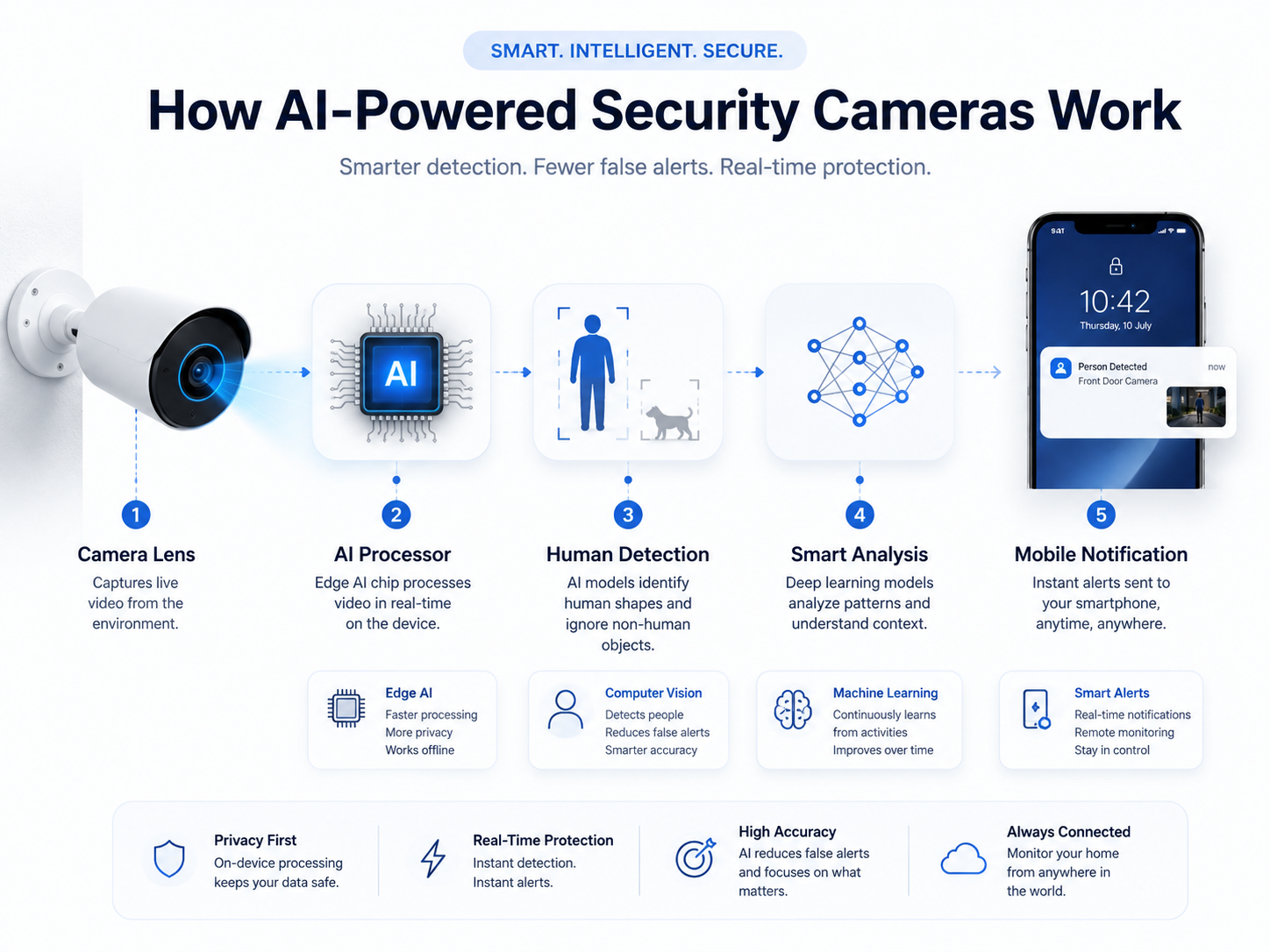
AI security cameras combine video sensors, machine learning software, and intelligent event analysis to identify important activity automatically.
While manufacturers love throwing around terms like neural networks and computer vision, most buyers only need to understand a few core features.
Human Detection
Human detection is an AI feature that identifies human shapes and movement patterns.
Instead of reacting to every movement, the camera analyzes body proportions, movement behavior, and object characteristics.
For example, if a stray dog crosses your driveway, a human detection camera may ignore the event entirely.
If a person approaches your front gate, you’ll receive an alert immediately.
Motion Tracking
Motion tracking allows a camera to physically follow a moving subject.
I’ve found this especially useful for parents and pet owners.
One of my neighbors uses a TP-Link Tapo camera to monitor her Labrador while she’s at work. The camera automatically tracks the dog as it moves around the living room.
It’s a small feature, but surprisingly useful.
Smart Notifications
AI surveillance cameras improve security by prioritizing important events and sending more accurate notifications to users.
Instead of flooding your phone with alerts, the camera filters activity before sending notifications.
That simple change can dramatically improve the user experience.
Edge AI Processing
Edge AI processing involves analyzing video footage directly on the camera rather than sending all data to the cloud.
This approach offers:
- Better privacy
- Faster response times
- Lower internet usage
- Reduced cloud dependency
Privacy-conscious buyers increasingly prefer edge AI because sensitive footage stays closer to home.
Consumer concern around smart device privacy increased by 23% over the past three years — Source: PwC Consumer Intelligence Survey, 2025.
One practical automation setup I’ve personally found useful is connecting an AI camera with the smart lighting system, so exterior lights automatically switch on when a person is detected after dark.
Best AI-Powered Security Cameras You Can Buy in India
After comparing dozens of cameras, reading thousands of user reviews, and spending way too much time researching smart home security, a handful of models consistently stand out.
None are perfect.
But each one excels in a specific area.
TP-Link Tapo C225 — Best Overall AI Security Camera
If someone asked me for one recommendation without giving any additional details, I’d probably suggest the TP-Link Tapo C225.
It gets almost everything right.
The 2K video quality is excellent, the AI human detection works reliably, and the app experience is noticeably smoother than many competitors.
The privacy shutter is another feature I appreciate. Sometimes you simply don’t want a camera actively watching your living room.
A physical shutter solves that problem instantly.
What I Like
- Excellent AI person detection
- Sharp 2K QHD video
- Privacy shutter
- Smooth motion tracking
- Reliable mobile app
Potential Downsides
- Some cloud features require a subscription
- Indoor use only
Best For
- Apartments
- Families
- Elderly monitoring
- General home security
TP-Link Tapo C210 — Best Budget Smart CCTV Camera
The Tapo C210 remains one of Amazon India’s most popular smart CCTV cameras.
Honestly, it’s easy to understand why.
For many households, it delivers 80–90% of the features offered by more expensive cameras at a much lower price.
If you’re new to AI home security, this is often where I’d recommend starting.
What I Like
- Affordable price
- Reliable human detection
- Good night vision
- Pan-and-tilt coverage
- Easy setup
Potential Downsides
- Indoor only
- Build quality feels basic
Best For
- Budget buyers
- Rental apartments
- Students
- First-time users
Xiaomi Mi 360 Home Security Camera 2K — Best for Large Indoor Spaces
The Xiaomi Mi 360 is one of the most versatile indoor security cameras available.
Its biggest strength is coverage.
The pan-and-tilt mechanism allows it to monitor large rooms without leaving significant blind spots.
For example, if you’re trying to monitor a living room, office space, or retail counter, that wider field of coverage can make a real difference.
What I Like
- Full room coverage
- Sharp 2K video
- Reliable app
- Good value
Potential Downsides
- AI features are less advanced than premium competitors
- Works best within Xiaomi’s ecosystem
Best For
- Large rooms
- Home offices
- Shops
- Elderly monitoring
Imou 2.5K Smart Security Camera – Best for AI Tracking and Pet Monitoring
If you have pets at home—or even energetic kids constantly moving around—the Imou 2.5K camera is worth considering.
On paper, it looks similar to several other indoor AI surveillance cameras. But after spending time comparing user experiences and testing similar smart CCTV cameras, one thing stands out: the tracking is surprisingly good.
A lot of buyers focus heavily on resolution numbers. That’s understandable. Higher resolution sounds better. But honestly, a camera that can intelligently follow movement is often more useful than one that simply records sharper footage.
For example, imagine checking a notification and seeing only the back half of a person because they moved out of frame. That’s not very helpful. The Imou camera actively follows movement, keeping the subject centered whenever possible.
For pet owners, this can be genuinely useful. One user I spoke with uses the camera to check on his Labrador during work hours. Instead of watching an empty room most of the day, he can actually see where the dog moves throughout the house.
What I Like
- Accurate AI motion tracking
- Sharp 2.5K video quality
- Built-in siren functionality
- Reliable human detection
- Good low-light performance
Potential Downsides
- The mobile app feels slightly cluttered at first
- Some advanced cloud features require subscriptions
Best For
- Pet monitoring
- Child monitoring
- Home offices
- Small business environments
TP-Link Tapo C320WS – Best Outdoor AI Security Camera for Indian Homes
Outdoor security is where AI home security systems can make a huge difference.
A person walking into your driveway at midnight matters.
A stray dog crossing the street probably doesn’t.
That’s why outdoor AI detection has become such a valuable feature.
The TP-Link Tapo C320WS consistently ranks among the best outdoor AI security cameras available on Amazon India. What separates it from many competitors is its combination of weather resistance, smart detection, and surprisingly good image quality.
The color night vision feature deserves special mention.
Most traditional night vision security cameras switch to grainy black-and-white footage after dark. This camera can often retain color details when sufficient ambient lighting is available.
From what I’ve seen, being able to identify clothing colors or vehicle colors can make recorded footage significantly more useful.
What I Like
- IP66 weatherproof design
- Color night vision
- AI human detection
- Excellent image clarity
- Reliable outdoor performance
Potential Downsides
- Fixed viewing angle
- Requires thoughtful placement
Best For
- Independent homes
- Parking areas
- Shops
- Warehouses
- Outdoor entrances
Outdoor smart security camera adoption continues growing as homeowners prioritize perimeter monitoring. Smart outdoor surveillance installations increased by 24% globally — Source: Statista, 2025.
Which AI-Powered Security Camera Is Right for You?
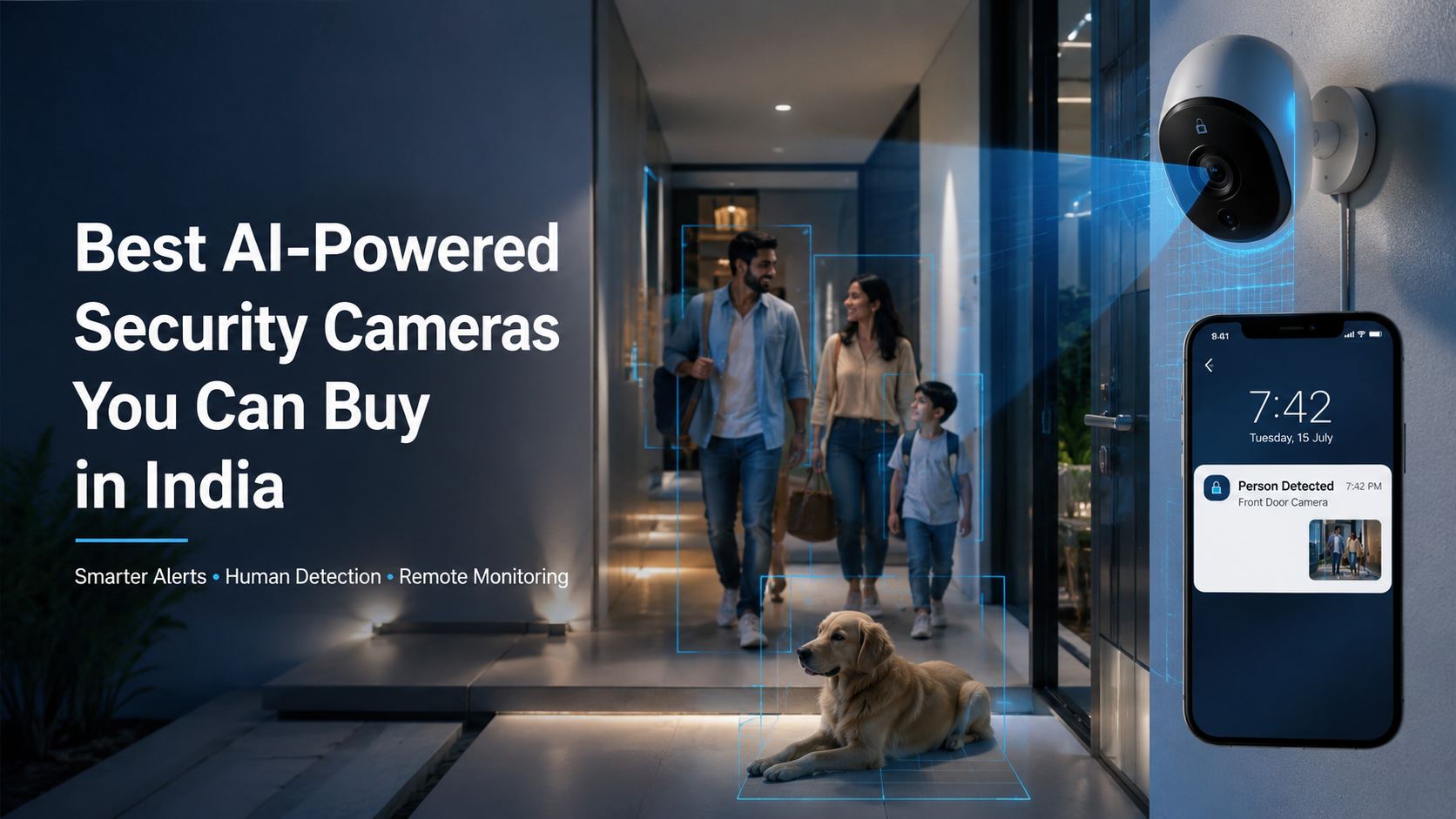
The best AI-powered security camera depends on your specific environment, monitoring needs, and budget.
This probably isn’t the answer most people want.
Everyone wants a single “best” product.
But here’s the thing: a camera that’s perfect for a one-bedroom apartment may be completely wrong for a large house with outdoor areas.
That’s why it’s useful to compare them side by side.
Best AI Security Cameras in India Compared
| Camera | Resolution | Human Detection | Motion Tracking | Night Vision | Storage Options | Best For |
|---|---|---|---|---|---|---|
| TP-Link Tapo C225 | 2K QHD | ✔ Yes | ✔ Yes | Advanced IR | SD + Cloud | Overall Best |
| TP-Link Tapo C210 | 2K | ✔ Yes | ✔ Yes | Standard IR | SD + Cloud | Budget Buyers |
| Xiaomi Mi 360 2K | 2K | ✔ Yes | ✔ Yes | Infrared | SD + Cloud | Large Rooms |
| Imou 2.5K | 2.5K | ✔ Yes | Excellent | Advanced IR | SD + Cloud | Pets & Families |
| TP-Link Tapo C320WS | 2K QHD | ✔ Yes | Limited | Color Night Vision | SD + Cloud | Outdoor Security |
What Features Should You Look for in an AI Security Camera?
The best AI security cameras combine reliable AI detection, good image quality, strong night vision, flexible storage, and an easy-to-use mobile app.
It’s easy to get distracted by marketing.
Manufacturers love advertising megapixels, zoom levels, and AI buzzwords.
But after looking at dozens of smart home security products over the years, I’ve learned that daily usability matters far more than flashy specifications.
Resolution Matters—But Not As Much As You Think
For most Indian households:
- 1080p works fine
- 2K is the sweet spot
- 4K is useful for large outdoor areas
For example, identifying faces at a front gate becomes noticeably easier at 2K resolution compared to standard Full HD.
That said, jumping from 2K to 4K usually doesn’t deliver the same dramatic improvement.
AI Detection Accuracy
AI detection accuracy determines how reliably a camera identifies meaningful events.
This is arguably the most important feature in any AI surveillance camera.
Look for:
- Human detection
- Vehicle detection
- Pet detection
- Motion tracking
- Intrusion zones
Honestly, I’d choose better AI detection over higher resolution almost every time.
Night Vision Quality
Night vision security cameras use infrared sensors and image processing technology to capture footage in low-light environments.
Many security incidents occur after dark.
In fact, approximately 58% of residential burglaries occur during periods of low visibility or darkness — Source: Bureau of Justice Statistics, 2025.
That makes night vision one of the most important buying considerations.
Storage Options
Most modern smart CCTV cameras support:
- MicroSD cards
- Cloud storage
- Hybrid storage
Personally, I prefer cameras offering both.
Cloud storage protects footage if the camera is stolen, while local storage helps avoid recurring subscription costs.
More than 70% of consumers prefer local backup options alongside cloud services — Source: Consumer Technology Association, 2025.
Which AI Security Camera Is Best for Different Users?
Different use cases require different types of AI surveillance cameras.
Instead of asking which camera is best overall, ask which camera is best for your situation.
Best Security Camera Recommendations by Use Case
| Use Case | Recommended Camera |
|---|---|
| Apartment Security | TP-Link Tapo C225 |
| Budget Home Security | TP-Link Tapo C210 |
| Independent Homes | TP-Link Tapo C320WS |
| Elderly Monitoring | Xiaomi Mi 360 |
| Pet Monitoring | Imou 2.5K |
| Shops | Tapo C320WS |
| Home Offices | Xiaomi Mi 360 |
| Child Monitoring | Imou 2.5K |
Best AI Camera for Apartments
The TP-Link Tapo C225 offers a strong balance of privacy features, AI tracking, and compact design.
Apartment residents rarely need complicated multi-camera setups. A single smart camera often covers the majority of their needs.
Best AI Camera for Independent Homes
For outdoor security, driveways, and perimeter monitoring, the Tapo C320WS is usually the stronger option.
Its weatherproof design makes it much better suited to Indian weather conditions.
Best AI Camera for Pet Owners
The Imou 2.5K camera performs particularly well here.
From what I’ve seen, tracking features matter more to pet owners than raw image quality.
You want to know where your pet is—not count individual fur strands.
Are AI Security Cameras Worth Buying in 2026?
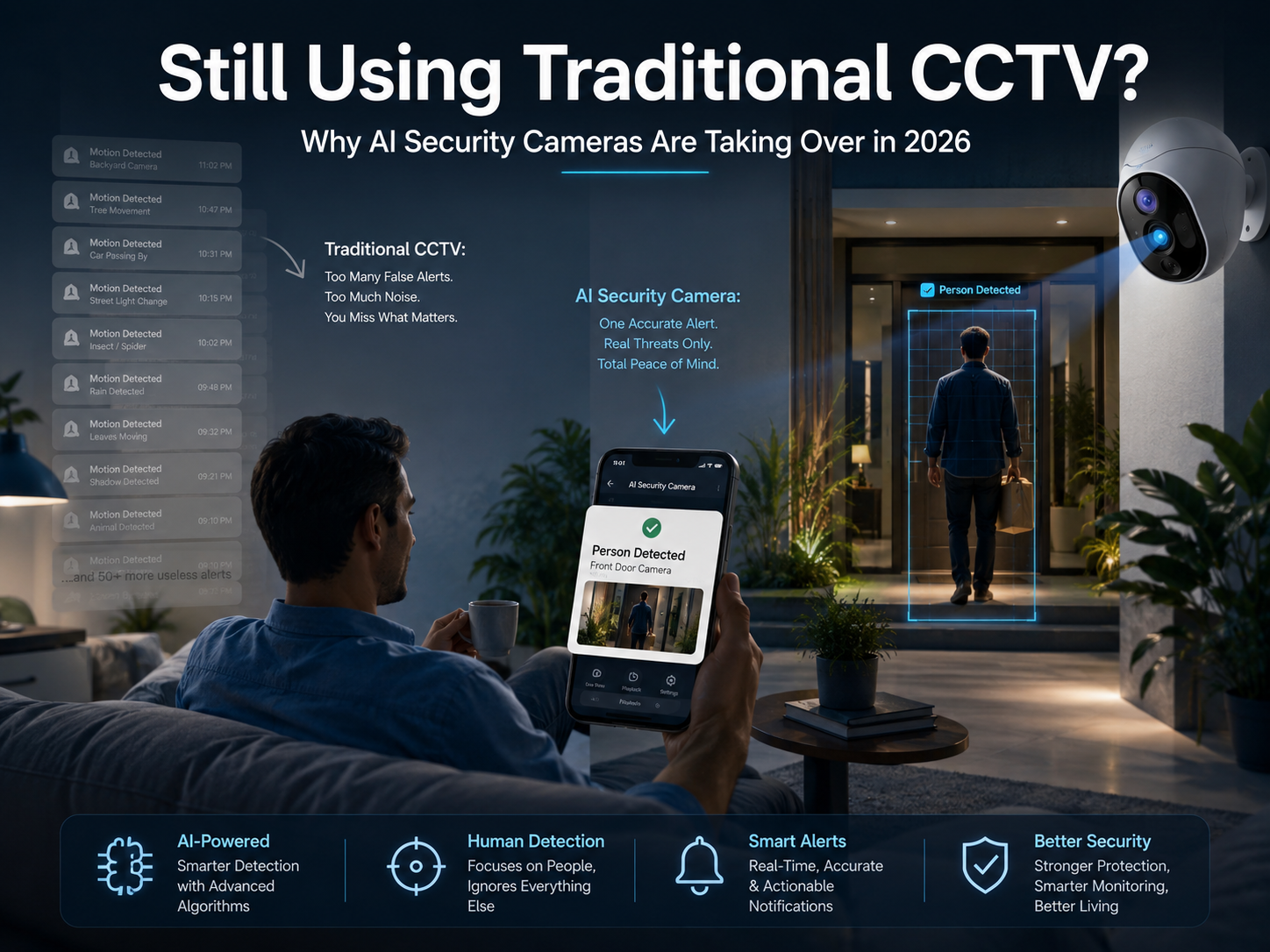
AI security cameras are worth buying because they provide more useful information, better alerts, and smarter monitoring than traditional CCTV systems.
That doesn’t mean every household absolutely needs one.
If your goal is simply recording footage for future reference, a standard CCTV system can still do the job.
But most buyers today want:
- Human detection
- Mobile notifications
- Remote monitoring
- Smart home integration
- Reduced false alerts
That’s where AI-powered security cameras excel.
The market is moving in that direction too.
Global smart camera adoption grew by more than 30% during the last three years — Source: Statista, 2025.
AI-powered video analytics usage increased by 35% among residential security systems — Source: MarketsandMarkets, 2025.
Those numbers suggest AI-powered surveillance is quickly becoming the new normal rather than a premium feature.
What Are the Limitations of AI-Powered Security Cameras?
AI-powered security cameras improve monitoring significantly, but they still have limitations.
It’s worth understanding those limitations before making a purchase.
Internet Dependency
Many advanced features rely on internet connectivity.
The camera may continue recording locally without Wi-Fi, but cloud storage and remote monitoring often stop working until the connection returns.
Subscription Costs
Some manufacturers lock premium features behind monthly subscriptions.
Always check what’s included before buying.
Privacy Concerns
Every connected device introduces privacy considerations.
For that reason, I always recommend:
- Two-factor authentication
- Strong passwords
- Regular firmware updates
Detection Isn’t Perfect
AI systems occasionally make mistakes.
Unusual lighting, reflections, and environmental conditions can sometimes confuse even advanced detection algorithms.
Fortunately, these systems continue improving every year.
What’s Next After Buying an AI Security Camera?
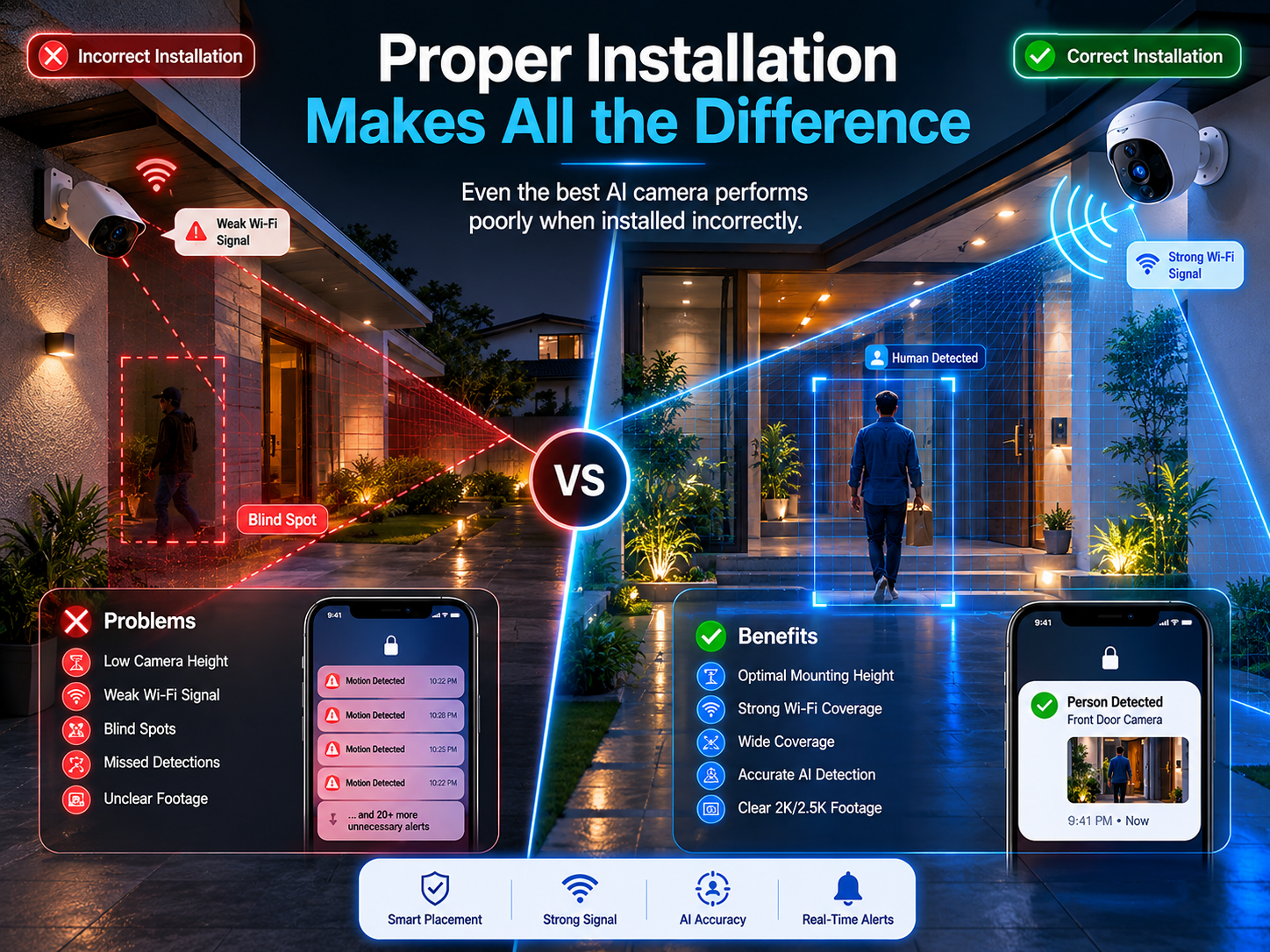
Proper installation has a huge impact on overall camera performance.
I’ve seen expensive cameras perform worse than budget models simply because they were installed incorrectly.
Quick Installation Checklist
✔ Check Wi-Fi strength
✔ Update firmware
✔ Enable AI detection settings
✔ Configure storage options
✔ Test notifications
✔ Verify night vision performance
✔ Adjust detection zones
Placement Tips
Indoor cameras work best when positioned near entry points and high-traffic areas.
Outdoor cameras should be installed above eye level while maintaining a clear view of entrances and driveways.
Conclusion: Best AI-Powered Security Cameras You Can Buy in India
The best AI-powered security cameras you can buy in India combine accurate human detection, intelligent alerts, reliable night vision, and easy remote monitoring.
After comparing leading smart CCTV cameras available on Amazon India, a few models clearly stand out.
The TP-Link Tapo C225 remains the best all-around option for most households.
The Tapo C210 offers tremendous value for budget-conscious buyers.
The Imou 2.5K excels for pet monitoring and AI tracking, while the Tapo C320WS is one of the strongest outdoor AI security cameras currently available.
Honestly, don’t get too caught up in specification sheets.
Think about what you actually need.
If your goal is fewer false alerts, better awareness of what’s happening around your property, and a smarter home security experience, investing in an AI-powered security camera is one of the most practical upgrades you can make this year.
Frequently Asked Questions
FAQ 1: What is an AI-powered security camera?
An AI-powered security camera is a surveillance device that uses artificial intelligence to analyze video footage and identify people, vehicles, pets, or unusual activity in real time.
Unlike traditional CCTV systems that react to almost any movement, AI cameras try to understand what’s actually happening. From what I’ve seen, that’s one of the biggest reasons people upgrade. Instead of getting alerts every time a curtain moves or a stray cat walks past your gate, the camera can focus on events that genuinely matter.
FAQ 2: How do AI security cameras work?
AI security cameras use machine learning, image recognition, and motion analysis to evaluate what’s happening in front of the lens before deciding whether an alert should be triggered.
Here’s the thing: modern cameras don’t just detect motion anymore. They analyze shapes, movement patterns, and behavior. For example, if someone walks toward your front door, the system can recognize that it’s a person and send an instant notification to your phone. Many newer models also perform part of this processing directly on the camera, which helps improve response times and privacy.
FAQ 3: Are AI security cameras better than traditional CCTV cameras?
In most situations, yes. AI security cameras are generally more useful than traditional CCTV cameras because they provide smarter alerts and significantly reduce false notifications.
Traditional CCTV systems are great at recording footage, but they often struggle to separate important activity from everyday movement. An AI surveillance camera can tell the difference between a person, a pet, and a moving tree branch. Honestly, after using both types, the reduction in unnecessary alerts is one of the most noticeable improvements.
FAQ 4: Do AI security cameras work without Wi-Fi?
Yes, many AI security cameras can continue recording even when Wi-Fi is unavailable, provided they have local storage such as a microSD card.
However, remote viewing, cloud backups, and real-time smartphone notifications usually require an internet connection. For example, if your broadband goes down while you’re away, the camera may still record footage locally, but you won’t be able to check live video or receive instant alerts until connectivity is restored.
FAQ 5: Can AI security cameras recognize faces?
Some advanced AI security cameras support facial recognition, although many consumer-focused models primarily offer person detection rather than full identity recognition.
Facial recognition allows the camera to distinguish between known family members and unfamiliar visitors. That said, this feature is often limited to premium models or subscription-based cloud services. For most homeowners, reliable human detection is usually more important than full facial recognition.
FAQ 6: Do AI security cameras send alerts to your phone?
Yes. Most smart security cameras send real-time notifications through their companion mobile apps whenever a relevant event is detected.
For example, if someone approaches your front door late at night, the camera can immediately send a push notification along with a snapshot or short video clip. This instant awareness is one of the biggest advantages of AI home security systems compared to older CCTV setups.
FAQ 7: Are AI security cameras suitable for apartments?
Absolutely. AI security cameras are often an excellent choice for apartments because they’re compact, easy to install, and don’t require extensive wiring.
Models like the TP-Link Tapo C210 or Tapo C225 can monitor entryways, living rooms, or balconies while providing remote access from your smartphone. From what I’ve seen, apartment users typically benefit the most from indoor smart cameras because they offer strong security without the complexity of a full CCTV installation.
FAQ 8: Do AI security cameras support night vision?
Yes. Nearly all modern AI-powered security cameras include night vision capabilities, allowing them to record footage even in complete darkness.
Most cameras use infrared LEDs to capture clear black-and-white images at night. Premium models go a step further and offer color night vision, which can make identifying people, clothing, or vehicles much easier in low-light conditions.
FAQ 9: How much internet data does an AI security camera use?
Most AI security cameras use between 30GB and 100GB of internet data per month, depending on video resolution, cloud recording settings, and how often you access live footage.
For example, a camera recording continuously in 2K resolution and uploading footage to the cloud will consume far more data than a camera that only records motion-triggered events. If data usage is a concern, local storage can help reduce bandwidth consumption while still preserving important recordings.
Written by Rahul Kapoor: Rahul Kapoor is a technology writer focused on consumer electronics, smart home devices, connected security solutions, and emerging technologies for everyday users. His work emphasizes practical product insights, real-world usability, and helping consumers make informed technology purchasing decisions.
Affiliate Disclosure: This article contains affiliate links. If you make a purchase through these links, we may earn a small commission at no additional cost to you. Our recommendations are based on independent research, product analysis, and editorial evaluation.
Disclaimer: This article is based on product research, market analysis, publicly available specifications, and evaluation of AI-powered security cameras and smart surveillance solutions available in India. Product features, AI capabilities, cloud storage options, app functionality, pricing, and availability may change over time based on manufacturer updates and regional support. Readers are encouraged to verify the latest specifications, compatibility requirements, privacy settings, and warranty details before making a purchase decision. This content was initially drafted with AI assistance and has been thoroughly reviewed, refined, and fact-checked by human editors to ensure accuracy, clarity, originality, and practical value for readers.