Stop Getting Burned by Fake Battery Claims: The Best Bluetooth Speakers for Travel in India
By Dhruv Malhotra | Technology Content Writer
Summarize this blog post with: ChatGPT | Perplexity | Claude | Grok
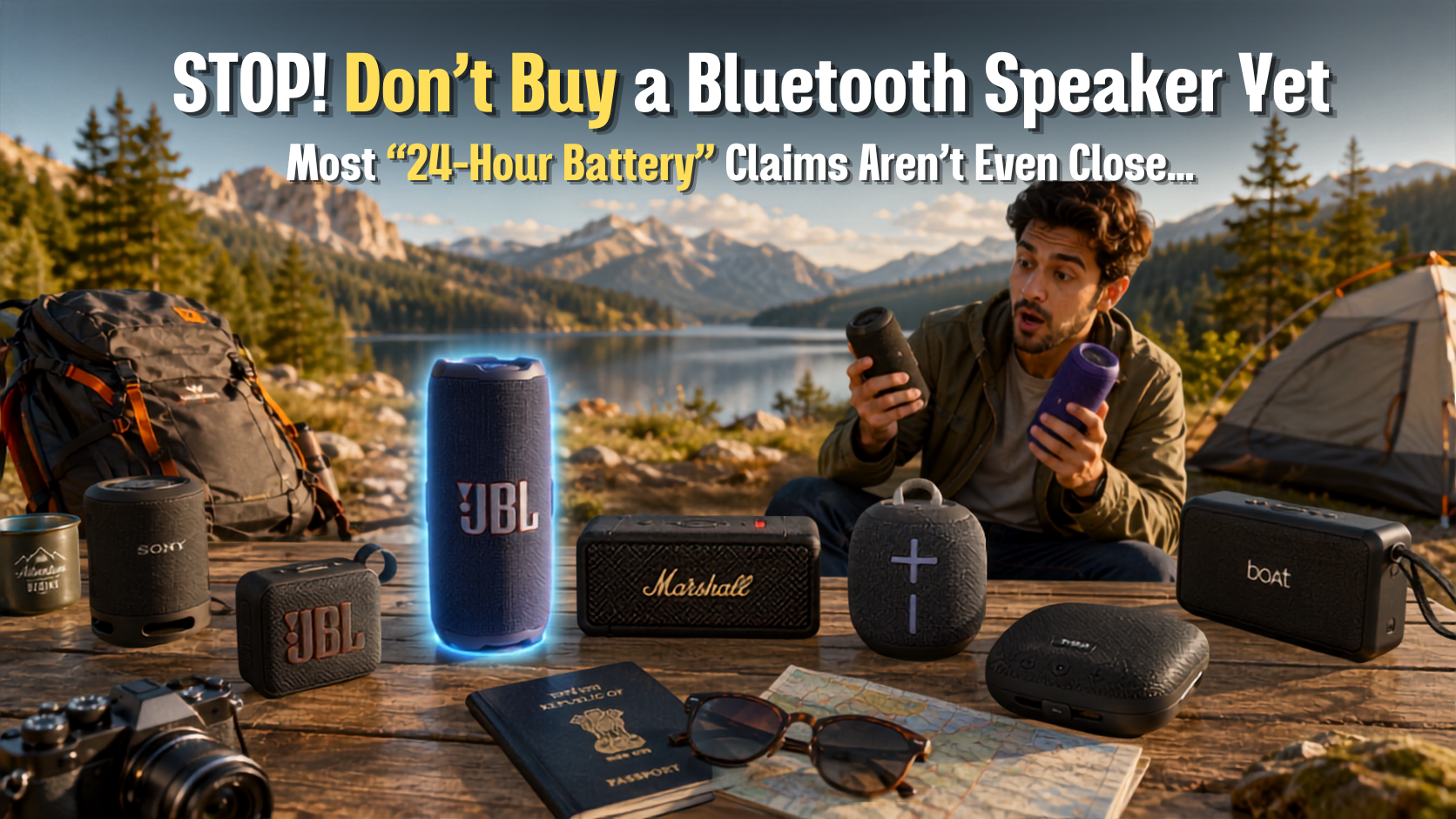
If you’ve ever packed a Bluetooth speaker for a trip only to watch it die halfway through the second day, you already know the marketing on the box and reality don’t always match up. That “24-hour battery” often means something closer to 10-14 hours once you’re actually playing music at a volume you can hear over wind or chatter. And that’s really the whole problem with shopping for travel speakers — most buying guides just repeat spec sheets instead of telling you what actually holds up once you’re out of your living room.
This guide is built around a simpler question: which Bluetooth speakers for travel genuinely earn their keep once you’re on a train, at a campsite, or lying on a beach in Goa? We’ll cover what actually matters (hint: it’s rarely the loudest speaker), walk through solid picks across price points, and flag where marketing tends to oversell.
Key Takeaways
- Battery life, water/dust resistance, and weight matter more for travel than raw volume or wattage.
- Marketed battery figures are usually optimistic — real-world use often runs 30-50% below the number on the box.
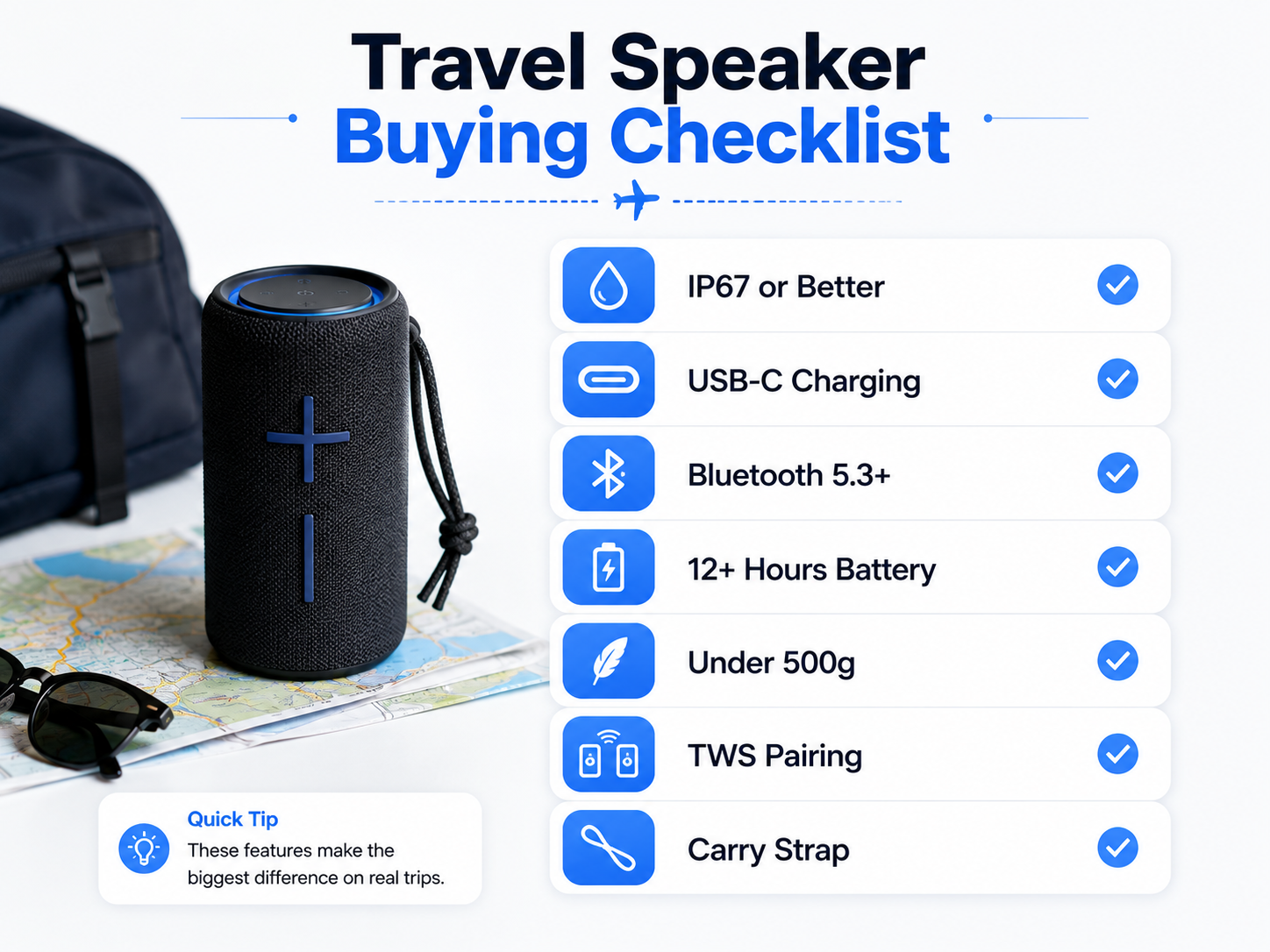
- IP67 is the sweet spot for most travelers: it covers dust, rain, and brief dunks without paying for overkill protection.
- Different trips need different speakers — what works for solo backpacking is overkill (or underpowered) for a family road trip.
- USB-C charging and Bluetooth 5.3+ are now baseline expectations, not premium features.
- Budget speakers can be a smart choice for casual or first-time buyers, but don’t expect the same lifespan as a mid-range or premium pick.
What Actually Makes a Bluetooth Speaker Good for Travel?
A good travel Bluetooth speaker is one that survives your actual trip, not just a product photo shoot. That means a compact, water- and dust-resistant build, a battery that lasts through a full day without hunting for an outlet, and enough durability to handle a drop off a hostel bunk or a dusting of beach sand. Not every leg of a trip calls for a speaker — for late-night flights or shared hostel rooms, we’ve rounded up the best neckbands in India worth packing instead.
Home speakers get to prioritize big drivers and maximum output because they never leave the shelf. Travel speakers can’t afford that luxury — they have to be light enough to disappear into a backpack pocket and tough enough to not care about rain, sand, or the occasional splash from someone doing a cannonball nearby. A speaker like the JBL Clip 5 or JBL Go 4, both well under 200 grams, illustrate this well: you genuinely forget they’re in your bag until you need them.
Here’s the thing though — “travel-ready” isn’t just a size claim. Plenty of speakers are compact but still splash-resistant at best, which isn’t the same as being genuinely dust- and waterproof. If you’re heading somewhere with actual outdoor exposure — a beach, a trek, a campsite — that distinction matters a lot more than shaving off another 50 grams.
How Long Should Battery Life Actually Be?
Aim for a marketed rating of at least 12-16 hours, and mentally discount it by roughly a third to a half for real-world use. Testers who’ve cross-referenced actual Amazon reviews rather than spec sheets have found that “12-hour” speakers often deliver closer to 5-6 hours of real playtime at a volume people actually listen at — Real-world battery life runs roughly 40-50% below marketed figures — Source: ProductHunter India, 2026. That gap matters most on multi-day trips where you can’t just plug in every night — camping, long train journeys, or anywhere charging access is unpredictable.
What Does an IP67 Rating Actually Mean?
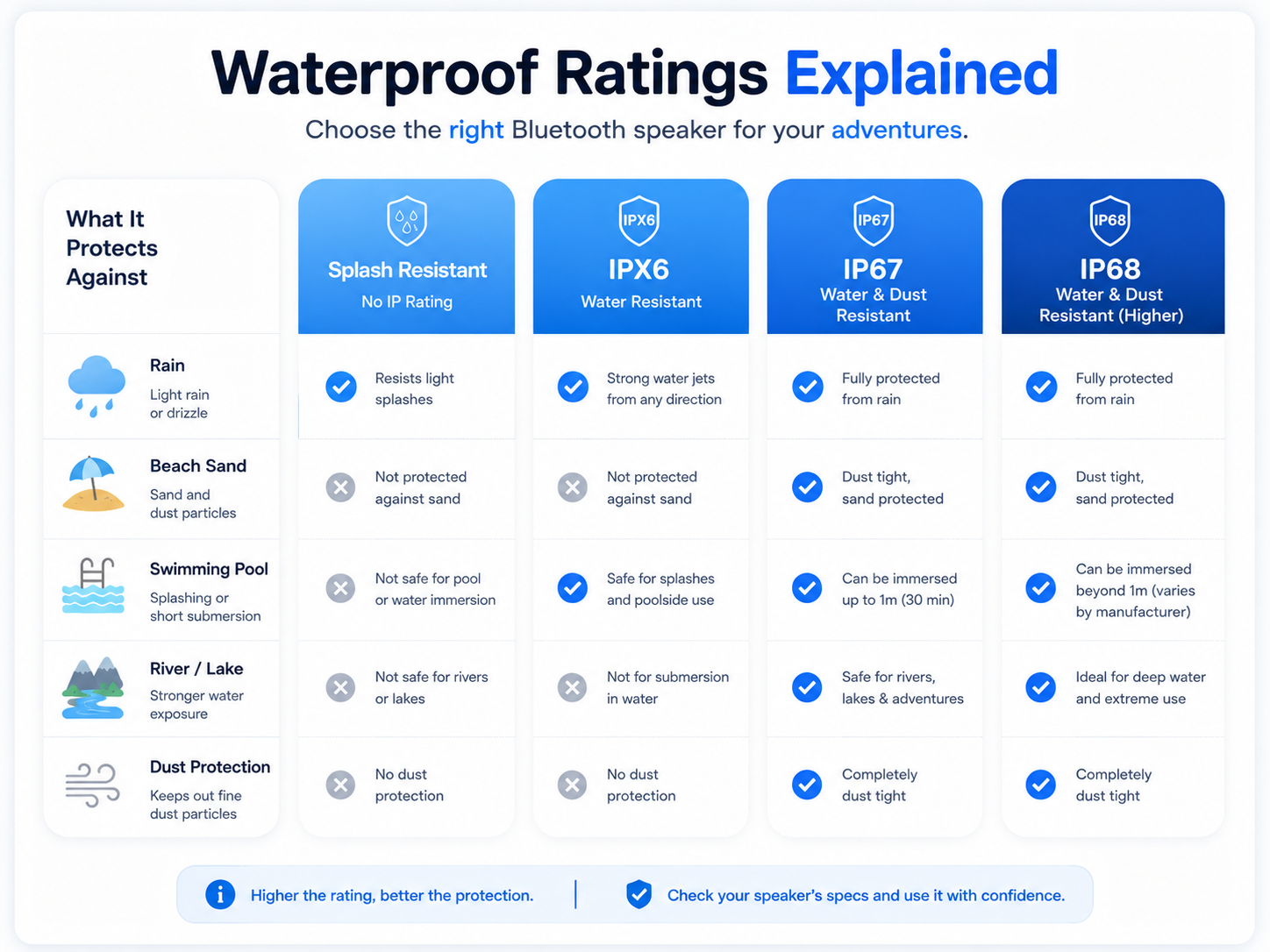
An IP67 rating means the speaker is fully sealed against dust and can survive brief submersion in roughly three feet of water. The first digit (6) covers dust protection; the second (7) covers water resistance. In practice, that’s enough for a sudden downpour mid-trek, an accidental knock into a pool, or a full day at the beach without babysitting it. IP68 goes a step further on water depth and duration, but for most travelers, that’s more protection than you’ll ever actually need — you’re paying for a scenario that rarely happens outside of scuba diving.
If work travel means podcasts, interviews, or content shoots on the go, pair your speaker setup with our guide to the best budget wireless mic with noise cancellation.
Does Weight Really Make That Much Difference?
Yes, more than most first-time buyers expect. Anything under roughly 300-500 grams disappears into a daypack; cross the 700g-1kg mark and you’ll notice it on a long walking day, even if it sounds fine at home. This is really a math problem more than a preference — if a speaker is annoying enough to leave behind, it’s not doing its job, no matter how good it sounds.
Can You Pair Two Speakers Together for Bigger Sound?
Yes — this is called TWS (True Wireless Stereo) pairing, and it lets two compatible speakers link wirelessly to create a fuller, stereo listening experience. Pairing two boAt Stone units, for example, can fill a hostel common room or campsite without needing to lug around one bulkier speaker. It’s a genuinely useful feature for group travel, though it obviously means buying two speakers instead of one, so it’s worth weighing against just buying a single larger unit.
Best Bluetooth Speakers for Travel in India (2026): Comparison Table
| Speaker | Battery (Claimed) | Waterproof | Weight | Bluetooth | Best For | Approx. Price |
|---|---|---|---|---|---|---|
| JBL Flip 7 ⭐ | Up to 16 hrs | IP68 | ~560g | 5.4 | Overall balance | Premium |
| Sony SRS-XB100 | Up to 16 hrs | IP67 | ~270–274g | 5.3 | Backpacking | ₹3,499–4,799 |
| JBL Go 4 | 7 hrs (+2 boost) | IP67 | ~190g | 5.3 | Ultra-light daily use | ₹2,000–2,500 |
| Marshall Emberton III | Up to 30+ hrs | IP67 | ~670–700g | 5.3 | Longest battery | ₹8,000+ |
| Ultimate Ears WONDERBOOM 4 | Up to 14 hrs | IP67 | ~420g | 5.3 | Beach / Pool trips | Premium |
| Tribit StormBox Micro 2 | Up to 12 hrs | IP67 | ~315–367g | 5.3 | Hiking / Cycling | ₹2,700–3,500 |
| Anker Soundcore Motion 300 | Up to 13 hrs | IPX7 | ~790g | 5.3 | Value for money | Mid-range |
| boAt Stone 1200 Pro | 7.5 hrs | IPX6 | ~600g | 5.3 | Suitcase / Carry-on travel | ₹3,499–4,999 |
| HAMMER Drop X1 | Claimed 32 hrs | Splash Resistant | Compact | 5.3 | Tight budget | ₹800–1,200 |
Prices and specs shift often on Amazon India, so treat this table as a starting point and check current listings before buying.
The Standout Picks, Broken Down
JBL Flip 7 — best overall balance. This is the speaker I’d point most people toward if they just want one good travel speaker and don’t want to overthink it. The Flip series has been a safe, dependable recommendation for years, and the Flip 7 keeps that reputation with better battery efficiency and an IP68 rating that covers you almost anywhere. It’s not the lightest option on this list, and bass-heavy listeners might find themselves wanting something bigger, but for most travel scenarios it just works.
Sony SRS-XB100 — best for backpackers and minimalists. At roughly 270 grams, this is genuinely easy to forget you’re carrying. It punches above its weight on bass and vocal clarity for something this small, and the included carry strap is a small but useful touch. If your priority is packing light — flying carry-on only, multi-day trekking — this is one of the more sensible picks in this price range.
Marshall Emberton III — best for long trips with limited charging. Over 30 hours of claimed battery life puts real distance between this and everything else on the list. Even accounting for the usual gap between marketed and real-world numbers, you’re still looking at a speaker that can realistically survive a long weekend without a charger. The trade-off is price and a bit of extra heft, so it makes more sense for road trips or camping than for someone trying to travel as light as possible.
Ultimate Ears WONDERBOOM 4 — best for beach and pool trips. The floating design is the real differentiator here — genuinely useful if you’re anywhere near open water, not just a gimmick. IP67-rated, tough housing, and loud enough for a beach day without needing to babysit it near the waterline.
JBL Go 4 — best if you just want background music without the bulk. This isn’t going to fill a room, and it’s not meant to. It trades power for portability, which is exactly the point — for solo listening on a train or hostel bed, that’s a completely reasonable trade.
Tribit StormBox Micro 2 — best for hiking and cycling. The integrated strap clips onto a pack or bike frame easily, and the build feels genuinely rugged rather than just marketed that way. Soundstage is smaller than the bigger units on this list, which is the expected trade-off for something this compact.
HAMMER Drop X1 — best if you’re on a tight budget. For under ₹1,200, getting decent output and a mic for calls is a reasonable deal. Just go in with the right expectations — after-sales support on budget brands tends to be thinner, and I wouldn’t expect this to still be going strong in three years the way a mid-range or premium speaker might.
Matching a Speaker to Your Type of Trip
Rather than chasing the “best” speaker in the abstract, it helps to match features to how you actually travel.
Backpacking or hiking: Prioritize weight and battery over volume — you’ll be carrying it for hours, not just listening for hours. The Sony SRS-XB100 or Tribit StormBox Micro 2 both make sense here.
Beach or pool trips: IP67 or better isn’t optional — sand and water exposure are close to guaranteed. The Ultimate Ears WONDERBOOM 4 and Sony SRS-XB100 both handle this comfortably.
Camping: Charging access is the real constraint, not sound quality. The Marshall Emberton III‘s battery life is genuinely useful here rather than just a nice-to-have.
Business travel: Compact size and clear call audio matter more than maximum output. Something like the Sony SRS-XB100 covers both without adding bulk to a laptop bag.
Road trips or family travel: You’ve got trunk space, so lean into a slightly larger speaker with better bass and higher max volume — the boAt Stone 1200 Pro or a similarly sized unit makes more sense than something ultra-compact.
Why Bother With a Dedicated Speaker at All?
It’s a fair question, given how good phone speakers have gotten. But physics still limits what a phone’s tiny driver can do, especially outdoors where wind and open space swallow sound fast. Over 80% of travelers say music improves their overall travel experience — Source: Expedia Travel Trends, 2025 — and it’s easy to see why once you’ve tried listening to a phone speaker on a windy beach versus a proper portable unit. The category isn’t shrinking either: portable Bluetooth speakers remain one of the fastest-growing segments in consumer audio — Source: Grand View Research, 2025.
Common Mistakes Worth Avoiding
Chasing loudness over battery life. A slightly quieter speaker that lasts 20 hours will serve you better on an actual trip than a loud one that dies after six.
Ignoring the difference between “splash-resistant” and IP67. These get used almost interchangeably in marketing copy, but they’re not the same thing — one survives a drizzle, the other survives a dunk.
Buying based on weight alone, ignoring build quality. A featherlight speaker that cracks after one drop isn’t actually saving you anything.
Skipping USB-C. At this point, carrying a speaker that doesn’t share a charging cable with your phone is just adding clutter to your bag for no good reason.
If budget is tight and portability matters more than shared sound, the best earbuds under ₹2000 with noise cancelling microphone round-up covers some solid alternatives.
A Few Habits That Extend Battery Life and Lifespan
Avoid charging to 100% every single time — partial charges put less long-term strain on the battery. Keep volume under roughly 80% where you can, since max volume is what drains a battery fastest and stresses the drivers hardest. And if you’re buying budget, go in with realistic expectations: a sub-₹3,000 speaker often delivers strong specs on paper but a realistic lifespan closer to 1-2 years rather than five, which is fine for a casual or first-time buyer but worth knowing upfront.
Conclusion
The best Bluetooth speaker for travel isn’t the loudest one on the shelf — it’s the one that matches how you actually travel. If you want one speaker that handles almost any trip without much thought, the JBL Flip 7 is a solid, low-regret choice. If you’re trying to pack as light as physically possible, the Sony SRS-XB100 is hard to beat. And if charging access is your biggest constraint — camping, long road trips — the Marshall Emberton III’s battery life alone justifies the higher price tag.
Whatever you land on, weigh real-world battery performance, IP rating, and weight more heavily than marketing claims about output or maximum volume. Speakers get chosen off spec sheets in stores, but they get judged on actual trips — and that gap is exactly where most buyers end up disappointed.
Frequently Asked Questions
FAQ 1: Which Bluetooth speaker is best for travel?
It depends on what you’re optimizing for. The JBL Flip 7 offers the best all-around balance of durability, sound, and portability, while the Sony SRS-XB100 is the better call if minimizing weight is your top priority.
FAQ 2: Is a waterproof Bluetooth speaker necessary for travel?
It’s not strictly necessary, but it’s a smart baseline. An IP67-rated speaker protects against dust, rain, and brief submersion, which covers the majority of outdoor travel scenarios without much added cost.
FAQ 3: How much battery life should a travel Bluetooth speaker have?
Look for at least 12-16 hours on the spec sheet, since real-world use tends to run 30-50% below the marketed number. Campers and road-trippers should aim higher — 20+ hours claimed — to build in a real buffer.
FAQ 4: Are small Bluetooth speakers loud enough for outdoor use?
For personal listening or small groups, yes. For open outdoor spaces or bigger gatherings, a larger speaker with more powerful drivers will noticeably outperform a compact one.
FAQ 5: Can I carry a Bluetooth speaker on a flight?
Generally yes — portable Bluetooth speakers with built-in lithium batteries are typically allowed in carry-on baggage, though it’s worth double-checking your specific airline’s battery capacity rules before flying.
FAQ 6: What does an IP67 rating actually protect against?
It means full protection against dust and the ability to survive brief submersion in about three feet of water — enough for rain, splashes, and accidental drops near a pool or beach.
Written by Dhruv Malhotra: Dhruv Malhotra is a technology content writer covering consumer electronics, digital products, and practical buying guides for everyday users. His work focuses on simplifying product research and helping readers compare features, understand key differences, and make informed purchasing decisions through clear, accessible, and research-driven content.
Affiliate Disclosure: This article contains affiliate links. If you purchase through these links, we may earn a small commission at no additional cost to you. This helps support our website and enables us to continue publishing independent buying guides and product recommendations. All featured products are selected based on editorial research and objective evaluation.
Disclaimer: This article is based on publicly available information, official product specifications, pricing trends, user feedback, and market research available at the time of publication. Product features, battery life, audio performance, connectivity options, pricing, availability, and promotional offers may change over time depending on the manufacturer and retailer. Readers are encouraged to verify the latest specifications, warranty details, compatibility, and current pricing from the official brand or authorized seller before making a purchase decision. This content was initially drafted with AI assistance and has been carefully reviewed, edited, refined, and fact-checked by human editors to ensure accuracy, clarity, originality, and editorial quality.